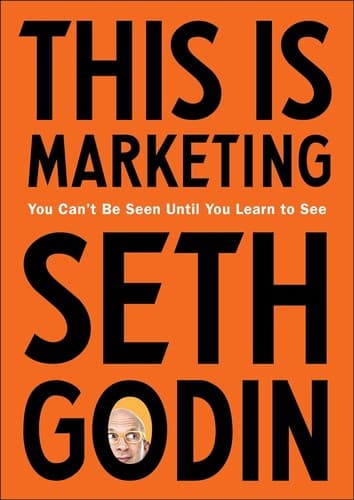
This Is Marketing
by Seth Godin · Published 2018
Good marketing isn't about reaching everyone; it's about understanding a specific group and creating something genuinely valuable for them.
What works
- Strong customer-centric philosophy.
- Excellent positioning ideas.
- Especially useful for small businesses.
- Challenges traditional mass marketing.
What doesn't
- More philosophical than tactical.
- Some ideas overlap with Godin's other books.
- Doesn't provide a complete execution framework.
Summary
In This Is Marketing, Seth Godin pushes back against the default assumption of industrial-era marketing: reach as many people as possible. His argument is that good marketing isn't about shouting at everyone — it's about finding the smallest viable market and building something that's genuinely, deeply valuable to that specific group. In his view, trying to please everyone usually produces a mediocre, forgettable product for everyone.
The book's other central claim is that people don't buy things for their technical specifications — they buy them for the change a product makes to their status, identity, or sense of belonging. Godin sums this up in the book's short, recurring line: "people like us do things like this" — meaning the consumer sees a product as a signal of membership in a group, not merely a tool for solving a problem.
The book also redefines "permission marketing," a concept Godin himself introduced years earlier: instead of interrupting someone's attention to get noticed, a marketer should earn their audience's trust and permission gradually, over time. In the end, Godin describes the marketer not as a salesperson forcing a product onto people, but as someone helping a specific group get where they already want to go — and that shift in framing is the backbone of the entire book.
Key ideas
1. The smallest viable market
Instead of targeting "everyone," Godin recommends focusing on the smallest group you can genuinely create value for and sustain a business on. That small group is a starting point that later expands through the very customers you've satisfied and who spread the word. The logic behind this is that a message designed for everyone usually isn't specific or persuasive enough for anyone; a message built precisely for one specific group becomes impossible for that group to ignore.
2. "People like us do things like this"
This line, repeated throughout the book, sums up Godin's view of what actually drives purchasing. He argues that a consumer usually buys a product not to solve a purely functional problem, but to confirm or build their own identity — membership in a group they define themselves by. Effective marketing, in Godin's view, has to target that group belonging, not just list the product's technical benefits.
3. Permission marketing
Godin borrows this concept from his own earlier books and redefines it here: instead of interrupting an audience's attention (intrusive ads, unsolicited email), a marketer should earn explicit permission to communicate gradually, through continuous value creation. That permission isn't won once and kept forever — it has to be reconfirmed with every interaction, and that's the key difference between permission marketing and interruption marketing.
4. Status and affiliation, not just benefit
Godin argues that the two things people actually want from their purchases are "status" and "affiliation" — not simply a product's function. A product might do exactly the same job as its competitor, but if it gives the customer a sense of higher status or belonging to a specific group, it gets chosen instead. This idea connects directly to his definition of marketing itself: marketing means changing something in the audience's world — their status or sense of belonging — not simply selling them an object.
5. Marketing to worldviews, not demographics
Godin warns that segmenting a market purely by age, gender, or income is often misleading, because two people with identical demographic profiles can have completely different worldviews, values, and buying motivations. His recommendation is that a marketer should target the audience's worldview — what matters to them, what they fear, what they hope for — rather than just their statistical bucket. This shift in angle, in Godin's words, turns the message from "advertising to a group" into "a conversation with a real person."
Who it's for
- Small business owners and freelancers — the "smallest viable market" framework is built precisely for someone without unlimited resources for mass marketing.
- Anyone getting acquainted with a customer-centric, anti-shouting marketing philosophy — the book offers a genuinely different view from traditional mass-advertising marketing.
- Anyone looking for a step-by-step execution framework — a precise campaign plan or an ad-budget formula, for instance — the book gives philosophy and a way of seeing, not an execution checklist.
- Anyone who's already read several other Godin books and wants entirely new ideas — some of this book's concepts (like permission marketing) also appear in his earlier work.
FAQ
What exactly does "smallest viable market" mean?
Instead of targeting a large, general market, find the smallest group you can genuinely create something valuable for and sustain a business on with just that group — a starting point for gradual growth, not a permanent limitation.
Does this book apply to large businesses too?
Yes, though Godin's main focus is on small businesses and freelancers. The book's principles — focusing on a specific group, permission marketing, attention to status and affiliation — are adaptable to any scale, but applying them inside a large organization needs some adjustment.
Why does the book say you shouldn't target everyone?
Because a message designed for everyone isn't specific enough for anyone. A precise, focused message works far more powerfully and persuasively for that specific group than a diluted, general one.
How is "permission marketing" different from traditional advertising?
Traditional advertising interrupts an audience's attention without permission; permission marketing earns explicit trust and permission gradually, through continuous value creation, and that permission has to be reconfirmed with every interaction.
How is this book different from Godin's Purple Cow?
Purple Cow focuses more on the idea of making a product remarkable and memorable; This Is Marketing offers a broader framework about the overall philosophy of marketing — from choosing a market to building trust and status — and situates those earlier ideas within that wider context.
Was this useful?
Counts appear once there are 5 votes.