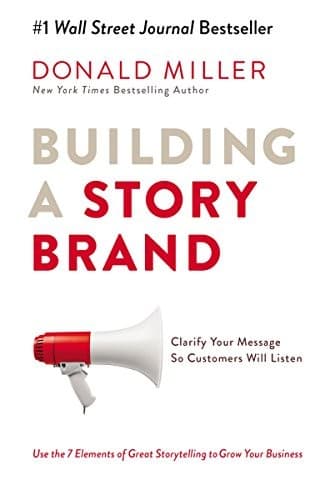
Building a StoryBrand
by Donald Miller · Published 2017
For anyone working in marketing it offers a simple, usable framework: brand messaging should be built around the customer's problem, not the company itself. A little oversimplified, but practical to apply.
What works
- Very easy to understand.
- Immediately applicable to marketing.
- Excellent messaging framework.
- Particularly useful for websites and landing pages.
What doesn't
- Simplifies branding.
- Not a complete marketing strategy.
- The framework can feel formulaic when overused.
- Doesn't address positioning and competitive strategy deeply enough.
Summary
Building a StoryBrand makes one simple claim that most brands violate: the customer is the hero of the story, not the company. Donald Miller argues that when a brand casts itself as the hero — "we're the best," "we're the industry pioneer" — the customer's brain, which is always conserving cognitive energy, tunes the message out. Miller's fix is to borrow narrative structure: every marketing message should make the customer the hero and position the brand as their guide.
The book's spine is a seven-part framework called SB7: a character (the customer) faces a problem, meets a guide (the brand) who gives them a plan, calls them to action, and the story ends in success or averts a failure that scares them. Miller doesn't claim this structure is new — he says it's borrowed directly from Joseph Campbell's hero's journey and Hollywood screenwriting — but he systematises its application to brand messaging.
The book's practical point, the one that separates it from narrative theory, is this: if a customer can't say in three seconds what you sell and why it matters to them after reading your website or hearing your ad, you've lost the message — no matter how beautifully it's written.
Key ideas
1. The brand is the guide, not the hero
Miller uses Star Wars to explain this: Luke Skywalker is the hero, but Obi-Wan and Yoda are guides who give him tools and a plan so he can win on his own. A good brand plays exactly that role — not the star of the story, but the competent mentor who helps the customer succeed on their own journey. The most common mistake brands make is casting themselves as Luke and expecting the customer to be a spectator of their story rather than the hero of their own.
2. A good guide has two traits: empathy and authority
A guide must show both that it understands the customer's problem (empathy) and that it has the capability to solve it (authority). Miller warns that most brands focus on one and forget the other: brands that only demonstrate competence come across as cold, and brands that only show empathy don't build trust. Balancing the two — "I know how you feel, and I know how to fix it" — is what makes messaging effective.
3. Three layers of problem: external, internal, philosophical
Miller argues most brands address only the customer's external problem — "your software is slow" — and ignore the internal problem (a feeling of inefficiency, anxiety) and the philosophical one (it simply isn't right for your business to waste your time). Powerful stories target all three layers, because a purchase decision is ultimately emotional even when its justification sounds rational.
If you confuse, you lose.
4. The call to action must be explicit and direct
Miller distinguishes two types of call to action: direct ("buy now," "book a call") and transitional ("download the free guide," "join the webinar"). His claim is that many websites either have no call to action at all or make it so vague the customer doesn't know the next step. A good brand always says exactly what the customer should do right now.
5. The grunt test: would a caveman understand?
Miller proposes an odd but practical benchmark: your brand message should be simple enough that a caveman with a grunt could understand it. If understanding what your company does takes multiple readings of a page, the message has failed. This simple test rejects a lot of flowery, jargon-heavy corporate website copy — what Miller calls "the curse of knowledge": when a business owner is so familiar with their product that they forget a new customer has none of that background.
Who it's for
- Anyone writing a website or landing page — the SB7 framework translates directly into a sales page structure.
- Anyone new to marketing — simple language and abundant examples make it a good entry point.
- A team whose brand messaging is scattered and inconsistent — the framework gives a shared vocabulary for discussing messaging.
- Anyone looking for competitive strategy or deep positioning — this book doesn't provide that; it focuses on message clarity, not strategic differentiation.
FAQ
How does it differ from other branding approaches?
Most branding books focus on visual identity or company values. This book focuses on one thing only: does the customer understand in a few seconds what you do and why it helps them. It's narrower, but exactly for that reason more actionable.
Does it work for a small business?
Yes, and arguably better than for large companies. A small business with clear, direct messaging can implement message clarity on its website much faster than a large company weighed down by marketing bureaucracy.
Does the grunt test actually change anything?
In practice, yes, because it gives an objective, fast benchmark. Instead of an endless debate about whether a sentence "sounds professional," you can ask: would someone with zero background understand this? That question shortcuts a lot of committee decisions about wording.
Does this framework work for any industry?
The narrative structure — hero, problem, guide — is nearly universal. But applying it is harder for complex B2B products than for simple consumer ones, because the actual customer (the decision-maker) and the hero of the story (the person using the product) are sometimes two different people.
Where is the best place to start applying it?
The website homepage. Miller says most visitors decide within seconds whether to stay or leave, which is exactly where the grunt test and an explicit call to action have the most impact.
Was this useful?
Counts appear once there are 5 votes.