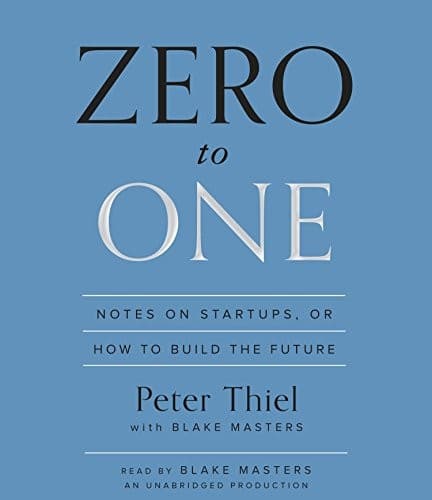
Zero to One
by Peter Thiel & Blake Masters · Published 2014
A good book about building businesses that are genuinely different rather than merely better than the competition. Some of Thiel's views are stated more absolutely than they deserve, but it is valuable for thinking about monopoly, innovation and competitive advantage.
What works
- Strong strategic thinking.
- Excellent discussion of monopoly and competition.
- Challenges conventional startup thinking.
- Encourages original thinking rather than imitation.
What doesn't
- Some arguments are intentionally provocative.
- Thiel's worldview is highly opinionated.
- Not a comprehensive startup manual.
- Some examples don't generalize well.
Summary
Zero to One grew out of Peter Thiel's entrepreneurship lecture notes at Stanford, and unlike most startup books it does not offer an execution manual. It takes a position. Its central question is: "What important truth do very few people agree with you on?" — and the whole book is an attempt to show why answering that matters more than any operational skill.
The title carries the distinction: going from zero to one means building something that did not exist; going from one to n means copying something that does. Thiel argues the world has become good at copying and weak at building, and that real value is almost always in the first category — because that is the only place where competition has not yet formed.
From there the book reaches its main and most contested argument: competition is not good for a business, it is good for the consumer. Thiel contends that companies producing durable profit are effectively monopolies — not in the legal sense, but in the sense that they do something nobody else does as well — while everyone in a competitive market watches their margin trend toward zero.
Key ideas
1. Competition is for losers
Thiel treats competition not as a sign of a healthy market but as a sign of missing differentiation. When several companies sell a near-identical product, the only remaining lever is price, and price falls toward the cost of production. The result is a market where everyone is busy and nobody profits.
All happy companies are different: each one earns a monopoly by solving a unique problem. All failed companies are the same: they failed to escape competition.
The practical point is that "how do we beat our competitors?" is usually the wrong question. The better one is what you could build that makes the comparison meaningless. Thiel warns that companies routinely define their market dishonestly — either so broadly that their share looks negligible, or so narrowly that it looks artificial.
2. Start with a small market
The book's least-quoted practical advice is also its most useful: the initial target market should be small and concentrated enough that you can dominate it. Dominating a small market gives you a base to expand from; a fractional share of a large one gives you no base at all.
His standing examples are Amazon starting with books and Facebook starting with a single campus. The logic is monopoly at small scale: when a product is clearly the best option for a specific group, growth comes from word of mouth rather than from a marketing budget.
3. Planning versus chance
Thiel separates four stances toward the future: indefinite optimism, definite optimism, indefinite pessimism and definite pessimism. His claim is that the modern world has slid into indefinite optimism — a belief that the future will be better without anyone holding a specific plan for it.
For business, this becomes a defence of long-range planning against rapid-iteration methods. Thiel has no patience for "test everything and see what happens"; he argues that decisive companies usually held a specific picture of the future and stayed with it for years. This is precisely where the book collides with lean and agile literature.
4. The power law and disproportionate significance
In venture capital, the return on one successful investment typically exceeds the entire rest of the portfolio combined. Thiel argues the same distribution holds for career and product decisions: efforts do not pay off evenly, and the gap between the best option and the second-best is usually far larger than it appears.
The practical consequence is focus. If outcomes are power-law distributed, spreading energy across several mediocre opportunities effectively means missing the only one that mattered.
5. Last mover advantage
Thiel pushes back against one of startup culture's most common beliefs: that being first to market is the decisive edge. His argument is that pioneers often just draw the map for everyone else, and later competitors learn from their mistakes and take the market. His example is Google, which was not the first search engine — Yahoo and AltaVista arrived earlier — but was the last significant mover that took the market for decades.
His point is not to start late. It is to aim at owning long-term cash flow rather than winning an early land grab. A company that becomes the last significant mover in a market captures the bulk of that industry's profit over years; a company that merely arrives first but cannot defend its position often builds exactly what the next competitor walks straight past.
Who it's for
- Anyone at the start of building something — the material on defining a market and starting from a small segment bears directly on early decisions.
- Anyone writing strategy — the monopoly-versus-competition frame is a good instrument for re-examining positioning.
- Anyone tired of startup literature — the book deliberately argues against the prevailing current, and that is its value.
- Anyone after original thinking — the opening question is a more useful exercise than any technique in the book.
FAQ
If I've read The Lean Startup, does this contradict it?
Yes, and that conflict is what makes reading both worthwhile. Ries says start small, test fast and pivot on feedback; Thiel says hold a long-range picture and stay with it. In practice neither is sufficient alone — Thiel is better for choosing the direction, Ries for travelling it.
What does he actually mean by "monopoly"?
Not a legal monopoly, but differentiation large enough that direct comparison stops making sense. The working definition is: if you can raise your price without customers leaving for a competitor, you have one. That definition applies as meaningfully to a small focused business as it does to Google.
Does it apply to non-technology businesses?
The strategy layer does; the examples do not. "What can we build that is incomparable?" is valid in any industry. But the economics behind the book's cases — near-zero marginal cost and network effects — are specific to software and do not hold in a services business.
Why is it so contested?
Because it treats competition, normally regarded as an economic virtue, as a failure. That position is defensible at the level of a single company and genuinely disputed at the level of a society: what is good for one firm's margin is not necessarily good for a market, and the book does not open that tension.
What stays with you longest?
The opening question: what important truth do few people agree with you on. Regardless of whether you accept Thiel's conclusions, it is a good thinking exercise and it works well beyond business.
Does "last mover advantage" mean starting late?
No. It means changing the metric for success. Thiel is not telling you to wait; he is telling you to drop the goal of being first to market and focus instead on building something you can still defend years later. Speed to market is not irrelevant, but on its own it is not enough.
Was this useful?
Counts appear once there are 5 votes.