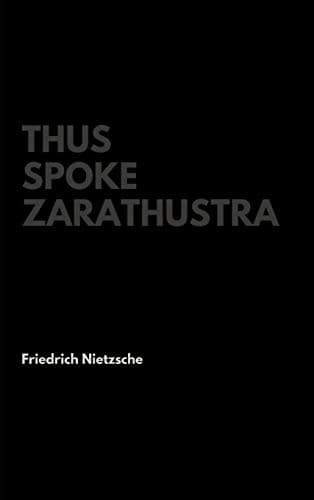
Thus Spoke Zarathustra
by Friedrich Nietzsche · Published 1883
Not a book you simply read and finish — it has to be wrestled with. Ideas like the will to power, self-creation and self-overcoming make it one of the most influential philosophical works on this list.
What works
- Philosophically rich.
- Powerful exploration of self-overcoming.
- Highly literary.
- Full of ideas that reward rereading.
What doesn't
- Extremely easy to misunderstand.
- Written symbolically rather than systematically.
- Some passages are intentionally provocative.
- Requires philosophical context.
Summary
Nietzsche wrote Thus Spoke Zarathustra not as an ordinary philosophical treatise but in the form of a half-poetic, half-scriptural narrative — Zarathustra, a self-made prophet, comes down from ten years of solitude in the mountains to tell people the teaching he has arrived at. But unlike traditional prophets, his message isn't a call to faith; it's a call to break free of ready-made beliefs and build self-created values instead.
Through Zarathustra's voice, Nietzsche makes a proclamation that forms the core of his entire philosophy: "God is dead." This is not a simple atheistic claim; it's a cultural diagnosis — the metaphysical and moral foundation of Western civilisation, built for thousands of years on belief in a fixed divine order, is no longer credible, and humanity now faces a void it must leap across on its own.
The book revolves around several central concepts that Nietzsche builds through allegory, poetry, and sometimes paradox rather than linear argument: the Übermensch (Overman — one who creates his own values), the will to power (a force Nietzsche treats as life's fundamental driver), and eternal recurrence (a thought experiment for testing whether you genuinely affirm your own life).
Key ideas
1. The death of God
The phrase "God is dead" is spoken by Nietzsche through a madman in a marketplace, who declares to an indifferent crowd that they themselves have killed God — meaning, through science, Enlightenment rationalism, and the gradual erosion of religious belief, the metaphysical foundation Western moral values stood on is no longer defensible. The problem, in Nietzsche's account, isn't that God never existed; the problem is that Western civilisation hasn't yet grasped the consequences of this collapse — it still behaves as though that foundation stands, while underneath it has already emptied out.
2. The Übermensch: one who creates his own values
If the divine foundation of morality has collapsed, the question becomes: how should a person live? Nietzsche's answer is the Übermensch (Overman) — not a superior race or a biologically different being, but an ideal of someone who, instead of accepting ready-made values (religious or social), creates their own values through creativity and personal will. Zarathustra explicitly says present-day humanity is merely a bridge — not a goal — between animal and Overman.
Man is a rope stretched between animal and Overman — a rope over an abyss.
3. The three metamorphoses: camel, lion, child
In one of the book's most symbolic sections, Nietzsche describes three stages of the spirit's transformation. The spirit is first a "camel" — a creature that voluntarily carries the heavy burden of imposed values and duties. It then becomes a "lion" — which fights a dragon named "Thou Shalt" to win back the freedom to say "I will," though the lion still cannot create new values, only destroy. Finally the spirit becomes a "child" — a symbol of innocence, a fresh beginning, and the ability to create new play and new value, free of the weight of the past.
4. The will to power
Nietzsche presents this concept not in the common, simplified sense of "a thirst for dominating others," but as a more fundamental force: the inner drive of every living thing to grow, overcome obstacles, and fully express its own capacities. He treats this as a replacement for traditional moral theories that explain human behaviour with concepts like "pleasure" or "survival"; in his view, even suffering and danger can be voluntarily accepted if they serve this same growth and self-overcoming.
5. Eternal recurrence: the test of life-affirmation
Nietzsche puts forward a radical thought experiment: imagine this exact life, exactly as it is — with all its suffering, joys and smallest details — repeating infinitely, with no change whatsoever. Would this thought bring you to your knees in horror, or would you embrace it with joy? This question, in Nietzsche's account, is the ultimate test of life-affirmation: someone who genuinely says "yes" to their life must be able to want even its endless repetition.
Who it's for
- Anyone ready to wrestle with a text rather than simply "read" it — this book needs rereading and reflection, not a single pass.
- Anyone interested in existentialist philosophy and questions of meaning — a direct precursor to much twentieth-century philosophy.
- Anyone who enjoys literary, poetic style in philosophy — Nietzsche here is more poet than academic philosopher.
- Anyone looking for a systematic, step-by-step introduction to Nietzsche's philosophy — this book is written symbolically and non-linearly, not as linear argument.
FAQ
Does "God is dead" mean Nietzsche was an atheist?
It's more complicated than a simple atheistic claim. Nietzsche is more interested in the cultural collapse of the West's metaphysical foundation than in the conventional debate over God's existence or non-existence — his concern is the consequences of that collapse for morality and meaning, not a theological argument.
Is the Übermensch the same as a racially superior human?
No, that's a distortion imposed on it later. Nietzsche's Übermensch is an individual, psychological ideal — someone who creates their own values — not a biological or racial category. Nietzsche himself kept a strong distance from the nationalism and racism of his time.
Is "eternal recurrence" a physical theory?
Nietzsche sometimes refers to it as a cosmological possibility, but its real importance is psychological and moral — not a scientific claim, but a thinking tool for measuring how much you affirm your own life.
Is this book a good starting point for Nietzsche's philosophy?
Opinions differ. Some consider it a difficult entry point because of its symbolic style and suggest starting with his more direct books (like Beyond Good and Evil) instead; others believe this exact literary style is a more compelling gateway into his thought.
Why is this book still so contested?
Because it questions common moral foundations without offering a simple replacement — leaving the reader alone with a void they must leap across themselves. That same ambiguity is both the book's main power and the reason for its historical misuse.
Was this useful?
Counts appear once there are 5 votes.