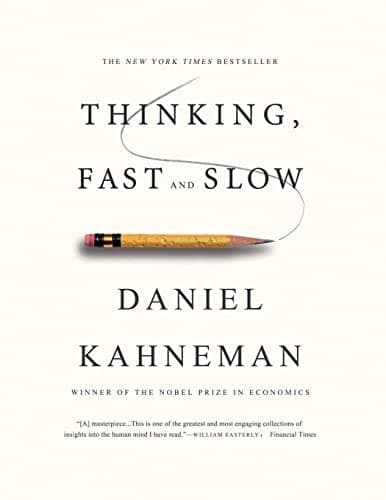
Thinking, Fast and Slow
by Daniel Kahneman · Published 2011
One of the most important books for recognising cognitive bias and the limits of human decision-making. Even if you don't accept every research detail, its two-system framework is enormously influential.
What works
- Excellent introduction to cognitive biases.
- Directly applicable to business and decision-making.
- Changes how you evaluate your own judgments.
- Strong connection between psychology and economics.
What doesn't
- Dense in places.
- Some findings associated with behavioral psychology have faced replication debates.
- Readers can become too eager to label every mistake as a "bias."
Summary
Thinking, Fast and Slow is the product of four decades of research by Daniel Kahneman and Amos Tversky — work that eventually won the Nobel in economics and more or less created behavioural economics single-handedly. Its central claim is simple and unwelcome: the human mind is not a logical calculating device, and the errors it makes are not random. They are patterned, predictable, and in most cases invisible to the person making them.
To explain those patterns Kahneman introduces two characters. System 1 is fast, automatic and effortless; it recognises a face, parses a simple sentence, and passes judgement without asking your permission. System 2 is slow, serial and expensive; it requires attention and therefore avoids working wherever it can. The trouble is that System 2 usually signs off on System 1's answer without reviewing it.
The rest of the book is a catalogue of situations where that division of labour fails: anchoring, availability, representativeness, framing, loss aversion and overconfidence. Kahneman nowhere claims these errors can be eliminated. His argument is that recognising high-risk situations is practical even when correcting the error in the moment is not.
Key ideas
1. Two systems, and which one actually decides
The value of this framework is not its biological accuracy — Kahneman says plainly that System 1 and 2 are a story, not brain structures — but that it explains a common mistake. We assume our judgements are the product of reasoning, when in most cases the reasoning arrives after the judgement and its job is justification.
System 1 is always on and always has an answer. If the question is hard, it quietly swaps it for an easier one — Kahneman calls this substitution. "Is this a good investment?" becomes "do I feel good about this company?" and you answer the second without noticing the question changed.
2. Anchoring
A number you see before making a decision shifts that decision — even when you know the number is irrelevant. In Kahneman and Tversky's experiments, spinning a wheel of fortune before asking for a numerical estimate dragged the answers toward whatever the wheel showed.
We cannot prevent the anchoring effect; we can only know where we are exposed to it.
The practical application in negotiation and pricing is direct: the first number on the table sets the range of the conversation. But the more important point for the reader is that awareness of a bias confers almost no immunity to it. Kahneman says the same about himself.
3. Loss aversion and prospect theory
The pain of losing a given amount is empirically about twice the pleasure of gaining it. That asymmetry explains behaviours that look irrational under classical economics: holding a losing position hoping to break even, refusing a fair bet, and clinging to the status quo.
Prospect theory follows from this and is the book's most important technical contribution: people evaluate outcomes not at absolute levels of wealth but relative to a reference point. Changing the reference point — that is, framing — can turn the same choice from attractive to unacceptable without a single number changing.
4. The experiencing self and the remembering self
The final section is quoted less often and may be the deepest part of the book. Kahneman shows that our evaluation of an experience is not its average; it is largely a function of the peak intensity and the ending. Duration is close to ignored — what he calls duration neglect.
The consequence is that we are two separate creatures: the one living the moment, and the one who judges it afterwards and makes the next decision. They frequently want different things, and life decisions are usually made by the second.
5. The Linda problem and the conjunction fallacy
The book's most famous experiment goes like this: Linda is described as thirty-one, single, outspoken and very bright, a philosophy graduate who as a student was deeply concerned with discrimination and social justice. Participants are asked which is more probable: "Linda is a bank teller" or "Linda is a bank teller and active in the feminist movement." A large majority pick the second — even though, by the logic of probability, this is impossible; a conjunction of two conditions can never be more probable than either condition alone.
Kahneman calls this the conjunction fallacy and shows that even graduate students trained in statistics fall for it. His explanation is that System 1 substitutes similarity to a familiar pattern (representativeness) for an actual probability calculation — and the description of Linda resembles a feminist far more than it resembles an ordinary bank teller. The experiment demonstrates that cognitive biases are not a product of low intelligence; they are a product of how thinking is structured.
Who it's for
- Anyone making high-stakes decisions — investing, hiring, pricing; anywhere judgement happens under uncertainty.
- Anyone designing products or interfaces — framing, anchoring and the peak-end effect translate directly into design decisions.
- Anyone who wants to audit their own judgement — the book is far more useful as a tool for calibrated self-distrust than as a tool for persuading others.
- Anyone new to behavioural economics — this is the primary source; most later books in the field are borrowing from it.
FAQ
Will I be less biased after reading it?
Almost certainly not, and Kahneman says so himself. Biases operate in System 1, which your awareness cannot reach. What you actually gain is the ability to recognise high-risk situations — and the practical fix is usually to change the process, not to try to think harder.
Given the replication debate, is it still worth reading?
Yes, with discrimination. The central findings — anchoring, loss aversion, framing, prospect theory — have been replicated many times and rest on solid ground. What has been most questioned is the social-priming work. The book's overall framework has not been seriously damaged by that debate.
How does it compare to Predictably Irrational?
Kahneman is deeper and more careful; Ariely is more readable and lighter. If you want to understand the mechanism, read this; if you want entertaining examples, read that. For someone reading only one, this is the better choice even though it is harder.
Is it applicable to management and business?
Yes, and its clearest application is in designing decision processes. Kahneman's discussion of the pre-mortem — assuming before a decision that it has failed and writing down why — is one of the few techniques that genuinely works at team level, because it changes the structure of the discussion rather than trying to fix an individual.
Where should I start if I can't read all of it?
Part One and Part Four. Part One builds the two-system framework, and Part Four (Choices) contains prospect theory and framing, which are the most applicable material in the book. The statistical middle sections can be returned to later.
Why has the Linda problem become so famous?
Because it shows the error has nothing to do with intelligence. Kahneman and Tversky ran the same experiment on Stanford graduate students in decision science — people who taught the rules of probability themselves — and got the same result. That is exactly what separates the book from a simple list of thinking errors: the error is structural, not a matter of education.
Was this useful?
Counts appear once there are 5 votes.