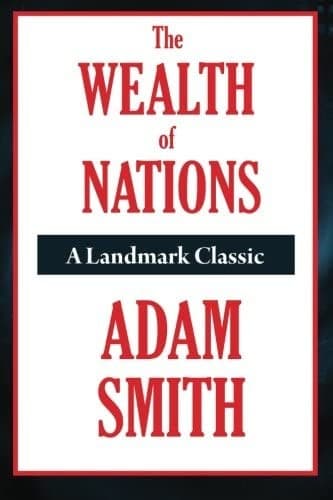
The Wealth of Nations
by Adam Smith · Published 1776
More than an economics book — one of the foundational texts for understanding markets, the division of labour, productivity and the formation of the modern economy. Reading it in full is not easy, but its historical and intellectual value is immense.
What works
- Foundational economic text.
- Excellent for understanding markets and specialization.
- Historically transformative.
- Much richer than the simplified "invisible hand" interpretation.
What doesn't
- Very long.
- Written in an 18th-century context.
- Some sections are difficult for modern readers.
- Not a modern economics textbook.
Summary
Adam Smith published The Wealth of Nations in 1776 — the same year the American Declaration of Independence was signed — and the book can be read as a declaration of independence for modern economics from Europe's traditional trade policy. Smith's central question is: what is a nation's real wealth, and where does it come from? The common answer of his era was: the gold and silver a country hoards in its treasury. Smith rejects this entirely.
His argument is that real wealth is not precious metal but a society's productive capacity — the goods and services its people make and consume. And the key to increasing that capacity is the division of labour: when each person specialises in a narrow task instead of trying to do everything, the productivity of the whole society rises dramatically.
The book then expands this idea into a complete system of political economy: how markets set prices, why government intervention and trade monopolies usually harm society, and why free trade between nations — contrary to the era's dominant mercantilist belief — can make both sides richer, not just one at the other's expense.
Key ideas
1. The pin factory: the power of specialisation
Smith opens the book with one of the most enduring examples in the history of economics. He describes a pin factory where, if one worker alone performed every step of making a pin, they might produce only a few pins a day. But when that same process is divided into eighteen distinct operations — one draws the wire, one straightens it, one cuts it, one sharpens the point — ten workers can produce over 48,000 pins a day; each person's productivity multiplies hundreds of times over. This example is the core of Smith's entire argument about the division of labour.
2. The invisible hand: order no one designed
One of economics' most famous — and most misunderstood — phrases comes from this book. Smith argues that when individuals pursue their own self-interest, they often, without intending it, produce an outcome that benefits society as a whole — as if guided by an "invisible hand." The subtle point is that Smith uses this exact phrase only once in his entire enormous book, not as a universal law of free markets without exception; today's simplified reading of the phrase has drifted far from the original text.
It is not from the benevolence of the butcher, the brewer, or the baker that we expect our dinner, but from their regard to their own interest.
3. The butcher, the brewer, the baker: self-interest as the economy's engine
In one of the book's most famous lines, Smith explains why an economy works without needing central benevolence: the butcher sells meat not because he cares about you, but because he cares about his income — and that exact self-interested motive forces him to offer quality meat at a competitive price so he doesn't lose your business. Smith treats this not as a moral justification for selfishness but as a description of a mechanism by which individual interests, with no central coordination, translate into the goods and services society needs.
4. The critique of mercantilism: why gold isn't wealth
A large part of the book is devoted to directly critiquing the dominant economic policy of Smith's time: mercantilism, which measured national wealth by accumulating gold and silver through more exports and fewer imports. Smith shows this view is mistaken: if a country has plenty of gold but its real productive capacity is weak, its people remain poor. Real wealth lies in the capacity to produce goods and services, not in metal sitting in a treasury.
5. Against monopoly and protective tariffs
Smith argues consistently against trade monopolies, guild restrictions, and protective tariffs — not from abstract principle, but because he believes these always benefit a small group (domestic producers) at the expense of the majority (consumers). He warns that producers always have a much stronger incentive to lobby politically than dispersed consumers do, and it's precisely this asymmetry of incentive that keeps protectionist policies politically popular despite their economic cost.
Who it's for
- Anyone who wants to understand the roots of modern economics from the original source — not through summaries and later interpretation.
- Anyone interested in the history of economic thought — the document that founded economics as an independent discipline.
- Anyone who wants to understand the "invisible hand" in its real context — not the simplified version repeated in today's political debate.
- Anyone looking for a modern economics textbook — this book isn't that; many of today's analytical tools (formal mathematical models, for instance) were developed after Smith.
FAQ
Did Smith really believe the market should be entirely unregulated?
No. In various parts of the book he explicitly defends a role for government in public education, infrastructure, and preventing monopoly. The image of "Smith the absolute libertarian" is more a product of later interpretation than of the text itself.
Why does the pin factory example get repeated so often?
Because it shows, concretely and measurably, why specialisation works — the precise figure of 48,000 pins a day turns the abstraction of "division of labour" into something imaginable.
Do I need an economics background to understand it?
Not formally, but knowing the mercantilist context of Smith's era — the thing he's writing directly against — helps explain why this book was so revolutionary in its own time.
Why is it still read after two hundred and fifty years?
Because its central questions — the role of government in markets, the real source of wealth, the effect of specialisation — remain at the centre of today's economic debates. The precise answers have changed, but the framework of the questions hasn't.
What's the best way to read it?
Book One, which contains the division of labour and the pin-factory example, is the most self-contained and accessible section. For a general reader, reading selections from Books One and Four (the critique of mercantilism) without drowning in every historical detail is the more common approach.
Was this useful?
Counts appear once there are 5 votes.