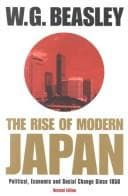
The Rise of Modern Japan
by W. G. Beasley · Published 1990
A dense, serious account of how Japan went from a traditional society to a modern state. Invaluable for understanding Japanese modernisation, though at times it is more historical than analytical.
What works
- Strong historical overview of Japan's modernization.
- Explains the Meiji transformation in useful context.
- Good for understanding state-building and industrialization.
- Relatively concise compared with many academic histories.
What doesn't
- Academic writing can feel dry.
- Less focused on ordinary people's experiences.
- Some political and economic developments could use more depth.
Summary
W. G. Beasley, a British historian and one of the leading specialists in Japanese studies, offers in The Rise of Modern Japan a dense, well-documented account of one of the fastest and most dramatic transformations in world history: how Japan, in under a century, went from a feudal, isolated society to one of the world's great industrial and military powers. The book begins in the late Tokugawa period and runs through the mid-20th century.
Beasley's central argument is that Japan's modernization shouldn't be understood merely as passive imitation of the West. He shows how Japanese elites, especially after the Meiji Restoration, selectively and deliberately combined Western technology and institutions with Japan's own political and cultural structures — a process that resembled purposeful redesign far more than simple copying.
The book pays particular attention to the state's role in directing industrialization — unlike the largely private, market-driven European model of industrialization, the Meiji government took a direct, centralized role in building infrastructure, industry, and the military. Beasley treats this pattern as key to understanding why Japan's modernization happened at such a startling pace.
Key ideas
1. The Black Ships and the end of Japan's isolation
The starting point of Beasley's narrative is the arrival of Commodore Matthew Perry's American fleet in 1853 — black-hulled steamships that forced Japan, after roughly two centuries of an official policy of isolation (sakoku), to open its ports to foreign trade. This event, known in Japanese history as the "Black Ships," was the initial shock that showed the Tokugawa shogunate's military and political structures couldn't withstand Western industrial power.
2. The Meiji Restoration: the end of the shogunate
In 1868, a coalition of dissatisfied samurai overthrew the Tokugawa shogunate, which had ruled Japan for more than two centuries, and restored formal power to the emperor — who was redefined as a symbol of national unity. Beasley shows that this event, known as the "Meiji Restoration," looked on the surface like a return to the past, but in practice became the vehicle for legitimizing the fastest program of political and institutional modernization of the era.
3. Abolishing the han system and administrative centralization
One of the key institutional changes Beasley details at length is the abolition of the feudal han system (local domains controlled by daimyo) in 1871 and its replacement with centralized administrative prefectures (haihan-chiken). This reform, carried out in a short time and without large-scale civil war, for the first time in Japanese history gave the central government direct control over taxation, the military, and lawmaking across the whole country — a necessary precondition for any nationwide industrialization program.
4. The genro and the "rich country, strong army" strategy
Beasley highlights the role of a small group of senior statesmen — known as the genro — in centrally directing modernization policy. Under the slogan "fukoku kyohei" (rich country, strong army), these elites simultaneously drove industrialization, education reform, the building of a modern military, and legal reform from the top down. This state-led development model, in Beasley's view, is the main difference between Japan's path and most European patterns of industrialization.
5. Victory in the wars against China and Russia
Beasley presents two wars as the ultimate test of the modernization program's success: the First Sino-Japanese War (1894–1895) and the Russo-Japanese War (1904–1905). Japan's victory in the second war, in particular, was the first time in the modern era that an Asian power had fully defeated a European power in a formal war — an event that not only redefined Japan's standing in the international system of that era but became a global symbol of the possibility of non-Western modernization.
Who it's for
- Anyone interested in East Asian history and non-Western modernization — Japan is the classic, widely referenced case study in this field.
- Anyone who wants to understand the state's role in rapid industrialization — Japan's state-led development model is still referenced in economic-development debates.
- Students of international relations and military history — the analysis of the Sino-Japanese and Russo-Japanese wars builds the necessary background for understanding early-20th-century East Asian geopolitics.
- Anyone looking for an account of ordinary people's lived experience — the book focuses mainly on the political, institutional, and economic level, not the everyday life of non-elite individuals.
FAQ
What were the "Black Ships"?
The arrival of Commodore Perry's American fleet in Japan in 1853, which forced Japan, after roughly two centuries of an official isolation policy, to open its ports to foreign trade — the starting point of Japan's path to modernization.
What was the "Meiji Restoration"?
The overthrow of the Tokugawa shogunate in 1868 and the restoration of formal power to the emperor, an event that in practice became the vehicle for legitimizing the fastest program of political and institutional modernization of that era.
What was the "rich country, strong army" slogan?
The strategic slogan of the genro — a small group of senior Meiji-era statesmen — who simultaneously drove industrialization, education reform, the building of a modern military, and legal reform from the top down.
Why does the victory in the Russo-Japanese War matter so much?
Because it was the first time in the modern era that an Asian power had fully defeated a European power in a formal war — an event that redefined Japan's international standing.
Was Japan's modernization simply imitation of the West?
No, in Beasley's view. Japanese elites selectively combined Western technology and institutions with Japan's own political and cultural structures — a process Beasley treats as purposeful redesign, not passive imitation.
Was this useful?
Counts appear once there are 5 votes.