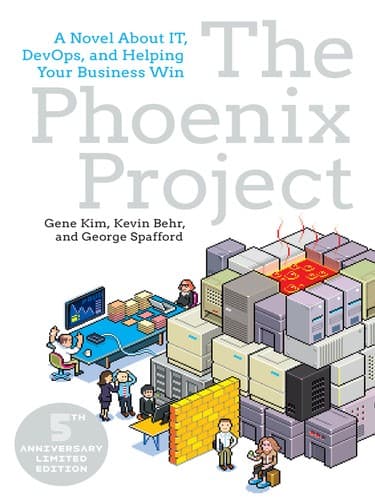
The Phoenix Project
by Gene Kim · Published 2013
Organizations improve when development, operations and the business optimize the flow of work across the entire system instead of optimizing isolated departments.
What works
- Excellent introduction to DevOps thinking.
- Very accessible narrative.
- Makes organizational bottlenecks understandable.
- Particularly useful for technical leaders.
What doesn't
- Simplifies organizational complexity.
- Characters sometimes function primarily as teaching devices.
- Less useful once you already understand DevOps deeply.
Summary
The Phoenix Project, by Gene Kim, Kevin Behr, and George Spafford, tells the principles of DevOps not through a dry technical text but as a workplace novel. The protagonist, Bill Palmer, is suddenly promoted to VP of IT Operations at a company on the verge of collapse — a critical initiative called "Phoenix" has been delayed repeatedly, systems keep failing, and instead of collaborating, the development and operations teams blame each other for everything.
Under the guidance of a character named Erik (clearly inspired by Eliyahu Goldratt's Theory of Constraints from his book The Goal), Bill gradually learns that the organization's real problem isn't one incompetent person but the structure of work flow across the entire system — from an initial business request all the way to a feature actually reaching the customer.
The book's central message, which the authors explicitly formulate in a closing appendix as "The Three Ways," is this: organizations improve when they optimize the flow of work across the entire system (not each department in isolation), rapidly feed feedback from the end of a process back to its beginning, and build a culture of continual experimentation and learning.
Key ideas
1. "The Three Ways" as the foundational framework
The book is organized around three central principles the authors call "The Three Ways": the First Way (Flow) means optimizing the movement of work from the start to the end of the system, not each individual workstation in isolation; the Second Way (Feedback) means building fast, continuous feedback loops between operations and development; and the Third Way (Continual Learning) means building a culture where experimentation, controlled failure, and gradual improvement are encouraged. These three principles are the backbone of what later became known as the DevOps movement.
2. Brent as the human bottleneck
One of the story's most instructive elements is the character of Brent — an engineer with such uniquely irreplaceable knowledge of the company's critical systems that nearly every urgent problem, directly or indirectly, traces back to him. Instead of being an asset, Brent has become the single tightest constraint in the entire system — nothing moves forward without him, and that dependency both burns him out and slows the whole organization down. Much of the story's arc revolves around identifying that exact bottleneck and unlocking his knowledge through documentation and team training.
3. The Theory of Constraints and the reference to The Goal
Erik, the story's mentor figure, repeatedly and explicitly points Bill to Eliyahu Goldratt's The Goal — a classic text on the Theory of Constraints in industrial manufacturing. The core lesson of that theory, transplanted into IT, is this: improving any part of the system that isn't the actual bottleneck has little effect on total output; the only real path to improvement is identifying the true constraint (in this story, Brent) and focusing all effort on that exact point.
4. The four types of work
One of the book's practical frameworks is classifying work into four types: business projects (visible, planned work), internal IT projects (infrastructure and maintenance), changes (small updates and fixes), and unplanned work (emergency firefighting). Bill learns that much of the organization's crisis comes from the fact that unplanned work — which usually stems from the poor quality of earlier work — devours the team's capacity and blocks progress on planned work.
5. Local optimization vs. global optimization
The story repeatedly shows that each department's effort to optimize its own performance — development for release speed, operations for system stability, security for control — can backfire at the level of the whole organization, because each team, defending its own metrics, ends up blocking the flow of work in other departments. The story's solution isn't for each team to work harder; it's for everyone to align around one shared goal — the flow of work across the entire system.
Who it's for
- Technical leaders and IT operations managers — the book gives a narrative, concrete view of organizational bottlenecks that a dry technical text can't convey the same way.
- Anyone newly encountering DevOps principles — the story format makes these concepts far more approachable than a purely theoretical text.
- Teams with recurring tension between development and operations — the book directly depicts exactly this organizational dynamic.
- Anyone who already knows DevOps deeply — the story format and the book's deliberate simplification likely won't add much new for this reader.
FAQ
What exactly are "The Three Ways"?
Flow (optimizing the movement of work across the entire system), Feedback (fast feedback loops between operations and development), and Continual Learning (a culture of experimentation and gradual improvement) — three principles that later became the backbone of the DevOps movement.
Why does the character of Brent matter so much in the book?
Because he's a concrete example of a "human bottleneck" — an employee whose critical knowledge exists only in his own head, which makes the whole organization dependent on him and slow. The story shows how that dependency needs to be resolved through documentation and knowledge-sharing.
Do I need to have already read Goldratt's The Goal to understand this book?
No, but a small amount of familiarity with the Theory of Constraints helps you follow Erik's arguments more deeply. The book itself re-explains that theory within the context of IT.
What are the "four types of work" the book introduces?
Business projects, internal IT projects, small changes, and unplanned work. The book argues that much of an organization's crisis comes from the fourth type — unplanned emergency work — overwhelming the team's capacity.
How useful is this book for someone who already knows DevOps deeply?
Less than for a newcomer. The book is mainly designed to introduce foundational concepts in an engaging format; someone already familiar with these principles may find much of the content repetitive.
Was this useful?
Counts appear once there are 5 votes.