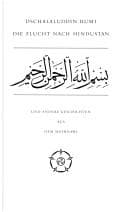
The Masnavi
by Rumi · Published 1273
A collection of stories about human desire, ego, love, ignorance and the search for a deeper understanding of oneself.
What works
- Extraordinary philosophical and literary depth.
- Endless layers of interpretation.
- Strong exploration of human nature.
- One of the foundational works of Persian literature.
What doesn't
- Requires cultural and historical context.
- Some stories are difficult for modern readers.
- Meaning can vary significantly between translations.
- Better approached slowly rather than read for speed.
As an affiliate, I may earn a small commission if you buy through this link — at no extra cost to you.
Summary
Unlike every other book on this list, Rumi's Masnavi (Masnavi-i Ma'navi, "Spiritual Couplets") is a 13th-century work and one of the foundational texts of Persian literature and Islamic mysticism. Rumi composed it not as a theoretical treatise but as thousands of lines of poetry woven through dozens of interlinked stories — tales of animals, kings, mystics, and ordinary people, each one a shell wrapped around a deeper point about the human ego, love, ignorance, and the search for meaning.
The book's structure isn't linear. Rumi leaps from one story to another, sometimes pausing mid-tale for a mystical reflection before returning to the same story. This narrative shape, which looks scattered at first glance, actually mirrors the book's own worldview: meaning is layered, and it's transmitted through story, metaphor, and repetition — not through linear argument.
Spanning six books and more than twenty-five thousand couplets, the Masnavi opens with one of the most famous passages in world mystical literature — the Song of the Reed. A reed, cut from the reed bed, cries out in separation from its source, and that cry becomes a metaphor for the human soul's condition, severed from its own origin. From that point on, the entire book is an attempt to trace the path back — through story, not through formula.
Key ideas
1. The reed's song: a metaphor for separation from the source
The opening eighteen lines of the Masnavi, known as the "Song of the Reed," are among the most famous passages in Persian literature: a reed, cut from the reed bed, now cries out in longing for it — a cry that is, in truth, the grief of every human being cut off from their own origin. Rumi makes this metaphor the starting point of the entire book: just as the reed's sound is only born once it's been cut from the reed bed and hollowed out, human meaning and maturity, too, are often only made possible through pain and separation.
2. The elephant in the dark
One of the Masnavi's most widely cited stories tells of several people touching an elephant in complete darkness; each one, depending on which part they touch (trunk, ear, leg), describes the elephant as something entirely different. Rumi uses this story to show the limits of partial perception: each of us, depending on our own narrow angle of experience, touches only a fragment of the truth and mistakes it for the whole — and that, in his account, is the root of much human argument and misunderstanding.
3. The grocer and the parrot
In this story, a grocer's parrot breaks a bottle of oil; the grocer strikes the parrot on the head, and the shock causes the bird to lose its feathers and stop speaking. Some time later, a bald-headed man passes by the shop, and the parrot, without understanding why, cries out: "Did you spill oil too, that your head went bald?" The parrot has confused its own condition (losing its feathers) with the grocer's condition (being bald) and drawn a false conclusion from a painful experience. Rumi offers this story as an example of hasty judgment and false generalization from a limited experience — a failing humans repeat just as often.
4. Moses and the shepherd
In one of the Masnavi's deepest and most debated stories, Moses comes across a shepherd speaking to God in simple, seemingly irreverent language — offering to wash God's feet and comb His hair. Moses rebukes him for this "impropriety"; the shepherd falls silent in shame. But revelation immediately comes down to Moses, chastising him for the rebuke: "Did you come to unite, or to divide?" Each person's language is measured by their own understanding, and simple, unadorned sincerity, on the scale of meaning, weighs heavier than hollow eloquence.
5. The three fish
The story of three fish — one clever, one half-clever, one foolish — trapped in a pond upon news that fishermen are coming, dramatizes three different responses to the same danger. The clever fish leaves the pond at once; the half-clever fish, through a trick (playing dead), escapes at the very last moment; and the foolish fish, who puts off the decision saying "I'll figure something out later," is ultimately caught. Rumi tells this story about the relationship between awareness, timely decision, and excessive delay — the longer a response is put off, the fewer options remain.
Who it's for
- Anyone interested in classical Persian literature and Islamic mysticism — the Masnavi is one of the most foundational texts in that tradition.
- Anyone ready to reread the text multiple times and reflect on each story — this book wasn't written for a single, fast read.
- Anyone seeking narrative-driven wisdom rather than a list of practical tips — meaning in the Masnavi emerges from within the story, not from direct statements.
- Anyone with no familiarity at all with the language and cultural context of classical Persian who wants to go straight to the original text without a guide — better to start with a translation accompanied by commentary.
FAQ
What exactly is the Masnavi?
A collection of mystical poetry in six books and more than twenty-five thousand couplets, composed by Rumi in the 13th century, addressing themes like love, ego, ignorance, and the search for meaning through story and parable.
Why should it be read "slowly"?
Because the meaning of many stories is layered and gets lost in a fast read; the text's cultural and historical context also demands reflection, not just following the plotline.
What's the "elephant in the dark" story about?
It's about the limits of partial perception — each of us, depending on our own limited experience, sees only part of the truth and often mistakes it for the whole truth.
Do I need prior familiarity with mysticism to read the Masnavi?
Full familiarity isn't necessary, but basic knowledge of the text's Qur'anic and mystical background makes the stories far easier to follow. Reading alongside a reliable commentary is recommended for a first-time reader.
What lesson does the story of Moses and the shepherd offer?
That simple, unadorned sincerity can be more valuable than hollow, polished eloquence, and that every person's language should be measured by their own understanding, not by one uniform surface standard of correctness.
Was this useful?
Counts appear once there are 5 votes.