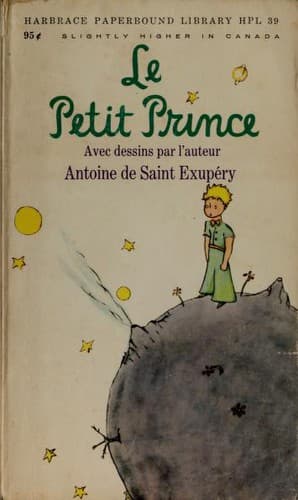
The Little Prince
by Antoine de Saint-Exupery · Published 1943
The things that give life meaning — relationships, responsibility, love and connection — are often invisible to superficial observation.
What works
- Simple but layered.
- Highly rereadable.
- Strong philosophical themes.
- Different meanings emerge with age.
What doesn't
- Can feel sentimental.
- Philosophical ideas are intentionally simplified.
- Sometimes the interpretation becomes deeper than the text itself.
Summary
The Little Prince looks, on the surface, like a children's book — a pilot crashes in the desert and meets a boy from a tiny asteroid — but Antoine de Saint-Exupéry actually wrote it for adults who were once children and have forgotten it. The narrator, a pilot stranded alone in the desert, tells the story of the little prince: his journey from his own asteroid, from one planet to another, where he meets symbolic characters — a king with no subjects, a conceited man who sees everyone as an admirer, a drunkard who drinks out of shame for drinking, and a businessman who counts stars in order to own them.
At the story's heart is the little prince's relationship with a rose on his own asteroid — proud and fragile, which he loves but hasn't been able to properly understand or express. His journey is, in effect, an attempt to understand something he finally reaches with a fox on Earth: the responsibility of love, and the fact that the most important things can't be seen.
The book is woven with a gentle but persistent critique of the adult world — people who care only about numbers (asking a house's age, not its colour) and have lost track of what actually matters. The book's simplicity of language is deliberate; its depth is hidden just beneath it.
Key ideas
1. "What is essential is invisible to the eye"
This line, spoken by the fox to the little prince, is the philosophical core of the whole book. The fox explains that only with the heart can one see rightly; the eye sees only the surface. Saint-Exupéry presents this not as a vague mystical slogan but as a precise observation about relationships, love and value: the real worth of a thing comes from the time and attention we've given it, not from its measurable properties.
2. Taming: a relationship is built with time
The fox asks the little prince to "tame" him — to build a bond. His explanation: before taming, the fox is just one of thousands of foxes and the little prince just one of thousands of boys; but after taming, each becomes unique to the other. This process takes time — the fox insists the prince come at the same hour every day, so that his own anticipation becomes part of the experience. This gives a practical definition of relationship: something built through invested time, not a sudden moment.
You become responsible, forever, for what you have tamed.
3. The rose and the responsibility of love
The little prince left his rose because he grew tired of her proud claims and contradictions — without understanding that behind that pride lay fragility and real love. Only after seeing a garden full of thousands of roses does he understand that his rose, despite her outward resemblance to the others, is unique — not because she is inherently better, but because he gave her his time: watering her, sheltering her from the wind, listening to her complaints. This is the same taming principle, but now with the real cost of regret attached.
4. Adults who only see numbers
Throughout the book, Saint-Exupéry portrays adults through their obsession with numbers: asked about a new friend, they want to know his age, how many brothers he has, or how much his father earns — not his voice or his favourite games. The book's opening scene — the pilot's drawing of a boa constrictor that has swallowed an elephant, and the adults who see it as a hat — establishes this exact idea from the very first page: adults see what they expect to see, not what is actually there.
5. The baobabs: small problems that become catastrophic if ignored
The little prince clears his asteroid of baobab seedlings every day — trees that, if left alone, will split the whole planet with their roots. Saint-Exupéry uses this as a metaphor for bad habits or ignored problems: something that looks like a trivial seedling at first can, if not attended to daily, destroy an entire life. The practical message is that small, daily care is cheaper than fixing a large crisis.
Who it's for
- Anyone who read it as a child and wants to reread it — the book's philosophical layers usually only reveal themselves on an adult rereading.
- Anyone thinking about relationships, responsibility and the meaning of connection — the taming metaphor gives a simple but precise framework.
- Anyone who wants a short but layered book — readable in one sitting, but each rereading gives something new.
- Anyone looking for explicit, direct philosophical argument — the book states its ideas through allegory and poetry, not logical argument.
FAQ
Is it really a book for adults?
Both. Children follow and enjoy the surface story — travelling between planets, strange characters; adults see the symbolic layers about love, responsibility and lost meaning that aren't accessible to a child.
What does the fox symbolise?
The fox is the teacher of the concept of relationship. He's the only character who teaches the little prince how real love and connection work — not through direct advice, but through the shared experience of being tamed.
Why does Saint-Exupéry criticise adults so much?
Not out of contempt, but out of longing. He was himself a pilot and knew the practical, number-obsessed adult world closely. His critique is an invitation to remember a childlike way of seeing, not a wholesale rejection of adulthood.
What does the ending mean?
The ending is deliberately ambiguous — the little prince's departure could be death, a return home, or simply separation. That ambiguity is part of the book's design: it lets the reader find whatever meaning they need in it.
Why is it still read after all these years?
Because each rereading gives a different meaning depending on the reader's age. A book that reads as adventure at ten reads, at forty, as being about loss, responsibility and the time we've given to others.
Was this useful?
Counts appear once there are 5 votes.