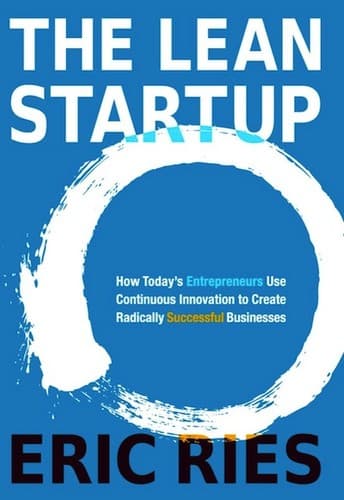
The Lean Startup
by Eric Ries · Published 2011
Build–Measure–Learn is still one of the most useful frameworks for building a product. Its strength is that it insists on learning from the market instead of guessing — though it doesn't fit every business equally well.
What works
- Highly practical.
- Strong emphasis on experimentation.
- Useful MVP framework.
- Particularly relevant to startups and product development.
What doesn't
- "MVP" is frequently misunderstood.
- Not every business can iterate cheaply.
- Can encourage excessive experimentation without a strong strategic direction.
- Some concepts are now common enough to feel less revolutionary.
Summary
The Lean Startup begins with a painful observation: most startups fail not because their team is weak or funding is insufficient, but because they spend years building a product nobody wants. Eric Ries, drawing on his own experience of his first company's failure (IMVU), argues that startup management should be more scientific — not in the sense of "plan more," but in a more precise sense: test every assumption about the customer as rigorously as a scientific hypothesis.
The book's spine is the Build–Measure–Learn loop: instead of building a complete product based on guesswork, build the smallest version that tests your core assumption, gather real data on customer behaviour, and either continue that path or change direction (pivot) based on it. The speed of this loop, not the initial size of the product, is the real measure of success.
Ries emphasises that "lean" doesn't mean small or cheap — it means eliminating any activity that doesn't contribute to validated learning. A company can spend millions and still be "lean" if every dollar tests a real hypothesis; and it can be entirely un-lean on a tiny budget if it spends months on something no one wants tested in the first place.
Key ideas
1. The Build–Measure–Learn loop
The core of Ries's methodology is this three-stage loop: build the idea in a testable form, measure real customer behaviour, and learn from the data whether the initial assumption held. The subtle point is that the goal is learning, not building. A team that builds fast but learns nothing from it is simply moving faster in the wrong direction.
2. The minimum viable product
An MVP is the smallest version of a product that lets you complete a full Build-Measure-Learn cycle — not necessarily a "small" product, but one that provides the minimum information needed to test the most important assumption. Ries cites the Dropbox example: before building the full product, the team made only a three-minute video showing how the product would work. That video, with no line of the final product's code behind it, proved real demand and took the waiting list from thousands to hundreds of thousands overnight.
The ultimate goal is not building a product — it's learning what should be built.
3. Innovation accounting: actionable metrics versus vanity metrics
Ries distinguishes between "vanity metrics" — numbers that always trend upward and feel good but don't drive a decision (like total signups since launch) — and "actionable metrics" that actually lead to a decision (like this week's conversion rate compared to last week's). He proposes that startups build an "innovation accounting" system so they can measure real progress even before profit exists.
4. The pivot: a strategic change of direction without losing what you've learned
A pivot is not a failure; it's a structured change of direction based on real learning. Ries's own company, IMVU, pivoted several times before arriving at its final model. He emphasises that early, cheap pivots are far better than persisting on a path the data has rejected — and the difference between a startup that succeeds and one that fails is often the number of pivots the team managed to make before the money ran out.
5. Engines of growth: three growth engines
Ries divides startup growth into three "engines": sticky (retaining existing customers better than they churn), viral (growth from the product's own use by users), and paid (customer acquisition cost lower than lifetime value). The key claim is that every business needs to identify which is its primary engine, because success metrics differ completely for each — optimising for the wrong engine wastes effort.
Who it's for
- A founder in the early stages of building a product — the book's core framework was built exactly for this moment.
- A product manager at a larger company — the principles of rapid experimentation apply beyond startups.
- Anyone familiar with Thiel's Zero to One — these two books offer complementary perspectives; one focuses on long-term direction, the other on rapid testing.
- Anyone running a business with a slow, expensive iteration cycle — like heavy industry or physical manufacturing — needs to adapt the principles more carefully.
FAQ
Does an MVP mean an incomplete version of the product?
No. An MVP means the smallest thing that lets you test a real hypothesis — sometimes even just a video or a landing page, with no actual product behind it. The common mistake is conflating it with "a lower-quality first version of the product."
Is the Dropbox example real?
Yes, it's one of the book's best-documented examples. The Dropbox team made a three-minute video of the product's hypothetical functioning before building the full product and released it. The response (a waiting list growing from 5,000 to 75,000 overnight) proved market demand without writing a single line of code.
Why do some say this book is no longer "revolutionary"?
Because many of its concepts — A/B testing, rapid iteration, MVPs — are now so embedded in product culture that they feel obvious. That's a sign of the book's influence, not a weakness in it; but for a reader already familiar with these concepts, parts may feel repetitive.
Does it apply to a traditional (non-tech) business?
The underlying principle — testing assumptions before investing fully — yes. But the rapid-iteration mechanisms the book proposes were designed for digital businesses and need redefining for industries with a slower physical cycle.
How does it differ from Zero to One?
Ries says start small, learn fast and change course based on data; Thiel says hold a specific long-term vision and stay with it. In practice most founders need both — Thiel for choosing the direction, Ries for travelling it.
Was this useful?
Counts appear once there are 5 votes.