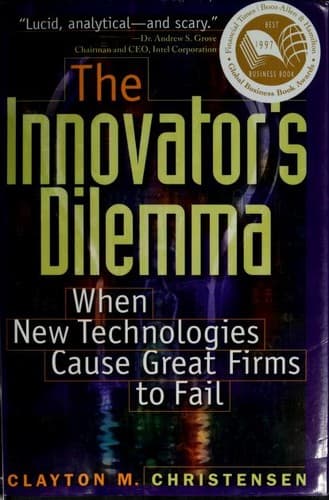
The Innovator's Dilemma
by Clayton Christensen · Published 1997
Successful companies can become vulnerable because the practices that make them successful today can prevent them from responding to disruptive technologies tomorrow.
What works
- Foundational innovation framework.
- Excellent strategic thinking.
- Explains incumbent failure well.
- Highly relevant to technology businesses.
What doesn't
- "Disruption" is frequently misunderstood.
- Not every new technology is disruptive.
- Some applications of the theory are debated.
Summary
In The Innovator's Dilemma, Clayton Christensen tackles a question that looks contradictory at first glance: why do large, well-managed companies — the ones doing everything "right," listening to customers, investing in the technology that's actually profitable, focusing on big markets — so often fail when new technology arrives? Christensen's answer is that the very practices that make a company successful in today's market are exactly what blind it to disruptive technologies.
The backbone of the book's argument is Christensen's case research on the disk-drive industry — an industry with short product cycles and transparent sales data that makes the pattern of disruption unusually visible. Successive generations of the technology (14-inch drives, then 8-inch, then 5.25-inch, then finally 3.5-inch) repeatedly toppled market leaders, not because their managers were incompetent, but because entirely reasonable business logic kept them from entering the new technology early.
Christensen distinguishes between "sustaining innovation" — which improves an existing product along the dimensions current customers already value — and "disruptive innovation," which starts out simpler, cheaper, and lower-quality but opens up a new market and gradually climbs into the main one. The book's central message is that large companies need separate organizational structures to pursue disruptive innovation, because the decision-making processes of an already-successful company systematically starve emerging, low-margin technology of resources.
Key ideas
1. Sustaining innovation vs. disruptive innovation
Christensen builds his entire framework on this distinction. Sustaining innovation improves a product along the exact metrics current customers already care about — faster, stronger, more precise. Disruptive innovation works the opposite way: it starts out weaker on those same core metrics, but offers something new — usually simplicity, low cost, or greater accessibility — that appeals to an entirely different, often smaller market. The problem for incumbents isn't that they fail to see disruptive technology; it's that by their current profitability metrics, it looks worthless.
2. The disk-drive industry as the foundational case study
Christensen grounds his research in a detailed history of the hard-disk-drive industry — one with short product cycles and clear sales data that makes the disruption pattern unusually legible. Each new drive generation (8-inch vs. 14-inch, 5.25-inch vs. 8-inch, then 3.5-inch) started out with lower capacity and held little appeal for the market leaders' core customers, but opened up a new market (desktop computers instead of mainframes). In nearly every generation, the leaders of the previous technology — despite ample financial and technical resources — failed to enter the next generation in time and dropped out of the race.
3. Value networks and organizational blindness
One of the book's deepest ideas is the concept of a "value network" — the set of customers, suppliers, and profitability metrics within which a company operates. Christensen shows that "good management" — listening closely to your most profitable customers and investing where returns are highest — is exactly what blinds a company to disruptive technology, because that technology initially holds no appeal for those same core customers. Failure, in other words, isn't the result of bad management; it's the logical outcome of good management applied within the wrong frame.
4. The mechanical excavator industry
To show that this pattern isn't unique to information technology, Christensen also examines the construction-excavator industry: the shift from cable-actuated to hydraulic technology. Manufacturers of cable excavators, optimized for large industrial projects, saw early hydraulic technology as worthless because of its lower capacity. But hydraulics first captured the small market of home excavation and small projects, then, through gradual improvement, moved into the same large industrial market — a pattern nearly identical to the disk-drive story, in a completely different industry.
5. Christensen's fix: the independent organization
Christensen's practical recommendation isn't for large companies to ignore disruptive technology, nor to throw all their resources at it — it's to build a small, independent organizational unit that can grow against its own success metrics rather than the parent company's. The classic example is IBM's personal computer division, launched in the 1980s as a team independent of the core mainframe business, able to respond to an emerging new market without getting tangled in the parent company's heavy decision-making processes.
Who it's for
- Managers and leaders at large, established companies — the framework directly explains why today's success can be the seed of tomorrow's vulnerability.
- Startup founders competing against bigger players — the book shows that entering from the bottom of the market, not head-on competition, is usually the more realistic way to challenge incumbents.
- Anyone working in an industry with fast technology cycles — software, semiconductors, transportation — where the disruption pattern repeats over and over.
- Anyone looking for a ready-made operational playbook — the book gives an analytical framework, not a step-by-step roadmap for a specific industry.
FAQ
What exactly does "disruptive innovation" mean?
Technology that's weaker on the core performance metrics current customers care about, but offers something new — simplicity, low cost, accessibility — that creates a different market and then gradually climbs into the main one. What separates it from simply "new, better technology" is precisely that path.
Does the book say the managers at failed companies were incompetent?
No, the opposite. The book's central argument is that these same competent managers, by logically following correct management practices, ended up failing. That's exactly what Christensen calls the "dilemma."
What's the book's solution for large companies?
Build small, independent organizational units that can grow against their own success metrics, rather than evaluating disruptive technology within the same structure and profitability metrics as the core business.
Why does the disk-drive industry matter so much in the book?
Because its data — short product cycles, transparent sales, successive technology generations — makes the disruption pattern demonstrable with clear quantitative evidence, not just a general claim.
Does this theory still apply to today's world?
Yes, though with some caution. Software industries and digital platforms have repeated this pattern many times over, but the widespread misuse of the word "disruptive" has diluted Christensen's original definition — going back to the source text is still valuable for understanding the concept precisely.
Was this useful?
Counts appear once there are 5 votes.