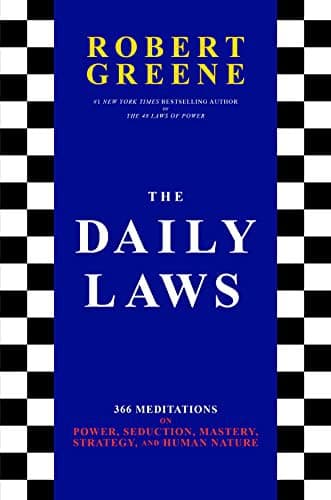
The Daily Laws
by Robert Greene · Published 2021
Plenty of ideas worth thinking about, but the daily, fragmented structure keeps it from reaching the depth of the philosophical or historical classics. Good for revisiting ideas, not a book that changes your understanding the way the others do.
What works
- Easy to consume.
- Lots of memorable historical examples.
- Good for reflection.
- Useful as a daily source of ideas.
What doesn't
- Repetitive.
- Some ideas are presented too confidently.
- Less depth than Greene's longer works.
- Better as a reference than as a serious book.
Summary
Unlike Robert Greene's other works, The Daily Laws isn't an independent, freshly written book — it's a 365-day selection extracted and rearranged from his five previous books (The 48 Laws of Power, The 33 Strategies of War, Mastery, The Laws of Human Nature, and The Art of Seduction). Each day offers a short passage — a law, a principle, or a historical lesson — paired with a quote and brief commentary.
The book's structure is organised around weekly and monthly themes: one week might focus on "self-knowledge," the next on "managing power relationships." This arrangement reorganises the scattered content of Greene's earlier books into a daily-consumable format, closer to a reflection calendar or daily reference than a continuous read.
The book's main value, according to the author's own introduction, is quick access to the core of Greene's ideas without having to read all five full books — its intent isn't to repeat or replace those works, but to condense them for daily review.
Key ideas
1. The principle of deliberately limiting speech
One of the book's standout laws, drawn from The 48 Laws of Power, is this: always say less than necessary. Greene argues that silence and ambiguity build power and mystique, while talkativeness — even when intelligent — reveals weakness and gives others the chance to find a vulnerability. In its daily format, this law is illustrated with compressed historical examples, from military leaders to politicians.
2. Compulsive behaviour: recurring behavioural patterns in others
Drawn from The Laws of Human Nature: Greene believes many people have fixed behavioural patterns that resurface, again and again, under pressure or in recurring situations — and once you've identified this pattern in someone once, you can predict their future behaviour with high accuracy. The daily version of this idea encourages the reader to record these patterns in people around them as predictive data, rather than as moral judgment.
Real power comes from a deep understanding of people and situations, not from superficial pretence or deception.
3. The pressure test: knowing yourself through crisis reaction
One passage drawn from Mastery says the best way to know your real capabilities isn't abstract reflection but observing your own behaviour in moments of pressure and crisis — because in those moments, surface habits and our constructed self-image fall away and the authentic reaction emerges. The daily version turns this into a weekly review exercise: revisit the last time you were under pressure and ask yourself what actually surfaced.
4. Indirect strategy
Drawn from The 33 Strategies of War: Greene argues that direct attack or negotiation often provokes more resistance, while an indirect approach — shifting the context, patience, or targeting a less-defended point — is usually more effective. The daily version compresses this idea through historical military examples, from Sun Tzu to nineteenth-century generals.
5. The book's function as a spaced-repetition tool
Perhaps the most honest description of the book itself is this: not a new work, but a tool for "spaced repetition" of Greene's ideas. Someone who has read the five core books keeps ideas that fade over time active again through daily review of these summaries — a mechanism closer to flashcards than to discovering a new idea.
Who it's for
- Anyone who has already read Greene's core works and wants to keep the ideas alive — exactly the function the book was designed for.
- Anyone looking for a daily reflection habit with historical content — the short format suits this goal.
- Anyone who hasn't read any of Greene's five core books and wants to start here — better to go directly to one of the original works instead; this summary lacks their depth.
- Anyone looking for a single, continuous book with a gradually built argument — the daily, fragmented structure doesn't provide that.
FAQ
Should I read this or one of Greene's original works?
If you haven't read any of them yet, go directly to The 48 Laws of Power or Mastery. This book is designed for someone who has already read those works and wants to keep the ideas fresh in mind, not for a first introduction.
Why is its rating lower than the other books on this list?
Because the daily structure sacrifices the depth of argument found in the original books. Each idea is closed off in a few lines, while in its source book it came with full historical examples and finer nuance.
Can it be started from any day?
Yes, that's exactly how it's designed. Unlike argument-driven books, the order in which you read the days doesn't matter much; you can start from any month or week.
Does its content contradict Greene's original works?
No, it's the exact same content, just condensed. Someone who has read one of the five books in full won't find anything contradictory here — just the same ideas presented more briefly.
What's the best way to use it?
As a daily supplement after having fully read at least one of the five core books, not as a substitute for them. Reading one passage a day, without rushing to "finish" the book, gives it exactly the function it was designed for.
Was this useful?
Counts appear once there are 5 votes.