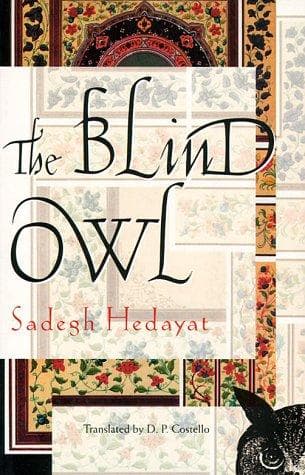
The Blind Owl
by Sadegh Hedayat · Published 1937
Reality, memory, obsession and perception can become so intertwined that the boundary between the external world and the inner one begins to disappear.
What works
- Distinctive literary voice.
- Psychologically intense.
- Symbolically rich.
- Landmark of modern Persian literature.
What doesn't
- Dark and difficult.
- Intentionally ambiguous.
- Not an easy casual read.
- Some passages require interpretation rather than literal reading.
Summary
Sadegh Hedayat's The Blind Owl (Buf-e Kur), first published in 1937 in Bombay in a limited print run stamped "not for sale or distribution in Iran," is one of the most influential and darkest works of modern Persian literature. The narrator, a pen-case painter, spends the book's first part recounting a dreamlike, anxiety-ridden narrative of his encounter with an ethereal woman and her death — a narrative in which the boundary between reality, hallucination, and memory is deliberately dissolved.
The book's second part, which appears more realistic at first glance, retells the same events in a different setting — with characters who this time carry clearer names and identities. But the same images, the same objects, and the same behavioral patterns (the odd-job old man, the ethereal woman, the small vial of poison) return in this section too, so that the reader is never certain which part is the "real" story, or whether that distinction even means anything.
With this book, Hedayat redefined the boundaries of the psychological and symbolic novel in Persian literature. His influence can be traced both in later Iranian literature and in international writers who later encountered the book in translation. The Blind Owl is usually read not as a novel with a linear plot, but as a journey through obsession, memory, and the gradual collapse of the boundary between the narrator's mind and the outside world.
Key ideas
1. The book's opening line
The Blind Owl opens with one of the most famous opening lines in Persian literature: the narrator says there are sores in life that, like leprosy, slowly eat away and scrape at the soul in isolation. This line, repeatedly quoted and referenced throughout Persian literature, sets the tone of the entire book from its very first sentence: a narrative of internal erosion, not a specific external event.
2. The mirrored two-part structure
One of the book's most distinctive structural features is its division into two parts that retell nearly identical events, images, and characters in two different settings — the first in a dreamlike, symbolic space, the second in a setting that appears more realistic but repeats the same patterns. This mirrored repetition, rather than resolving the ambiguity, deepens it — the reader never arrives at certainty about which narrative is "real."
3. The odd-job old man
One of the book's recurring, unsettling images is the character of the "odd-job old man" — an old man with a distinctive laugh and a recurring presence who appears at key moments in both parts of the book. This character is never fully explained; he functions more as a symbol of a fixed inner fear than as a character with a clear narrative background, and that ambiguity is part of what builds the book's hallucinatory atmosphere.
4. The pen-case painting
The narrator, a pen-case painter, paints one fixed image over and over: a cypress tree, a stooped old man beneath it, and a girl offering him a flower. This image, apparently painted before the story's main events take place, later recurs unsettlingly in the story's "real" scenes — as though the painting had prophesied the event in advance, or the event were merely a reflection of that same primordial image. This recurring visual loop is one of the book's central symbolic elements.
5. The book's publication history
The publication history of The Blind Owl is itself part of the legend surrounding it: fearing censorship in Iran at the time, Hedayat first published the book in an extremely limited run (roughly 50 copies) in Bombay, mimeographed, stamped on the cover with "sale and distribution in Iran forbidden." Years later, after the political climate shifted, the book was able to be officially published in Iran — a history that itself mirrors the stifling, secretive atmosphere present within the text.
Who it's for
- Anyone interested in modern Persian literature and its place in world literature — The Blind Owl is a landmark in that history.
- Anyone ready to reread a symbolic, non-linear, psychological text multiple times and reflect on it — this book wasn't written for a single, casual read.
- Anyone interested in existentialist literature and literary explorations of a troubled mind — Hedayat is often placed alongside writers like Kafka and Poe.
- Anyone in a psychologically vulnerable state, or looking for something light and uplifting — the book's atmosphere is dark, depressive, and deliberately unsettling.
FAQ
What is The Blind Owl about?
It's the account of a narrator whose obsession, memory, and perception intertwine so thoroughly that the boundary between outer reality and his inner world gradually dissolves — a symbolic story about isolation, death, and mental collapse, not a novel with a simple linear plot.
Why wasn't the book first published in Iran?
Hedayat feared political censorship of that era, so he first published the book in a limited run in Bombay, stamped "not for sale in Iran" on the cover. The book was officially published in Iran years later.
What does the book's two-part structure mean?
The book's two parts retell nearly identical events and images in two different settings — one dreamlike, the other apparently more realistic. This mirrored repetition deepens the ambiguity about the story's "reality" rather than resolving it.
What does the odd-job old man symbolize?
He's never fully explained; he functions more as a symbol of a fixed, unsettling inner fear than as a character with a clear narrative background.
Is this book suitable for a reader new to Persian literature?
It can be difficult. The book is deliberately ambiguous and symbolic and calls for repeated reflection; reading it alongside a commentary or literary analysis can make the first encounter more accessible.
Was this useful?
Counts appear once there are 5 votes.