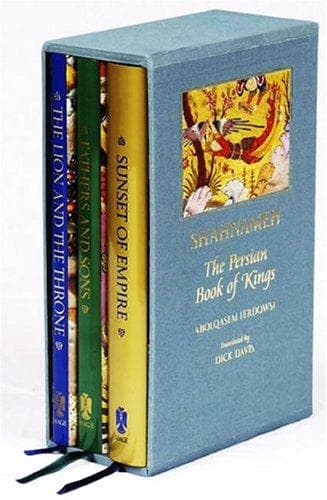
Shahnameh
by Ferdowsi · Published 1010
Through generations of kings and heroes, the Shahnameh explores power, ambition, loyalty, justice, fate, identity and the impermanence of human achievement.
What works
- Foundational Persian literary work.
- Extraordinary storytelling.
- Huge cultural and historical significance.
- Deep exploration of power and human nature.
What doesn't
- Very large.
- Requires historical context.
- Some sections are difficult for modern readers.
- Selected editions can be easier to approach.
Summary
Ferdowsi's Shahnameh, composed around 400 AH (the early 11th century) after roughly thirty years of work, is one of the greatest poetic epics in the world and the backbone of modern Persian literature. Ferdowsi wrote it with the explicit goal of keeping the Persian language alive, at a time when Arabic cast a long shadow over Iran's official culture — and, in a famous line of his own, claimed "I have revived the Persians through this Persian tongue."
The Shahnameh's structure moves through three broad eras: the mythical age (the creation of the world, the first kings like Jamshid and Fereydun), the heroic age (in which Rostam, the epic's central hero, plays the leading role), and the historical age (which reaches the Sasanian kings and the Arab conquest of Iran). This gradual movement from myth to history is itself a reflection of Ferdowsi's view of Iranian identity — legend and reality woven into a single continuous narrative.
The Shahnameh's central themes — power, ambition, loyalty, justice, fate, and the impermanence of human achievement — are told through dozens of interlinked stories about kings and heroes. Unlike many other world epics, the Shahnameh doesn't offer clean-cut good and bad kings; even its most beloved characters, like Rostam, commit at least one catastrophic mistake somewhere in the story.
Key ideas
1. Rostam and Sohrab
One of the Shahnameh's most tragic stories is Rostam's battle with Sohrab — a son Rostam never knew he had. Sohrab, raised by his mother Tahmineh, faces Rostam in single combat without knowing he's fighting his own father. Only after mortally wounding him does Rostam discover, through an armband on Sohrab's arm, that he has killed his own son. This story is one of world literature's deepest explorations of unintended tragedy and the hidden cost of war.
2. The Simorgh and the raising of Zal
Zal, son of Sam, is abandoned by his father at birth because of his white hair, and is raised on Mount Alborz by a mythical bird called the Simorgh. Years later, when Zal becomes a father and his wife Rudabeh runs into a dangerous labor with Rostam, the Simorgh returns and teaches Zal the method of a caesarean birth — a passage some scholars consider one of the oldest literary references in the world to that surgical procedure. This story ties together abandonment, unconventional upbringing, and, ultimately, the rescue of the next generation.
3. Zahhak and the snakes growing from his shoulders
Zahhak, the Shahnameh's mythical tyrant king, grows two snakes from his shoulders after being kissed there by the devil — snakes that, to stay calm, must be fed human brains every day. His reign lasts a thousand years, during which the youth of Iran are sacrificed to feed those same snakes. Zahhak became the Shahnameh's explicit symbol of tyranny and structural oppression — an image that, a thousand years after it was written, is still used in Persian literature and political discourse as a metaphor for oppressive rule.
4. Kaveh the Blacksmith and the Derafsh Kaviani
In the face of Zahhak's tyranny, Kaveh, a simple blacksmith whose children have been sacrificed to Zahhak's snakes, raises his workshop's leather apron on a spear and calls the people to rise up. This simple, working-class banner, later adorned with jewels, becomes the "Derafsh Kaviani" — the official standard of ancient Iran until the Arab conquest. Kaveh's story is one of the few passages in the Shahnameh where an uprising of ordinary people, not a single hero or king, is the main driver of historical change.
5. The Seven Labors of Rostam
One of the Shahnameh's most famous epic sections is Rostam's seven trials to rescue Kay Kavus, king of Iran, from the White Div in Mazandaran. Across these seven labors, Rostam confronts a lion, thirst, a dragon, a sorceress, and finally the White Div himself — each stage a separate test of strength, wit, or endurance. This seven-stage structure became a narrative template later reproduced in many other heroic tales in Persian literature.
Who it's for
- Anyone interested in classical Persian literature and Iranian cultural identity — the Shahnameh is the cornerstone of that history.
- Anyone interested in world epics (the Iliad, Beowulf) who wants to know the Persian counterpart — the Shahnameh ranks among the greatest epics in human history in both scale and depth.
- Anyone ready to read parts of the text with a guide or in a selected edition — the book is enormous, and starting with a good selection makes for a far easier entry point.
- Anyone looking for a short, standalone story — the Shahnameh is a continuous, interwoven work; its stories find their fullest meaning within the context of the whole.
FAQ
What is the Shahnameh about?
A poetic epic about the mythical and heroic history of Iran, from the creation of the world to the Arab conquest, exploring themes like power, justice, fate, and the impermanence of human achievement through the stories of kings and heroes.
Why is the story of Rostam and Sohrab so famous?
Because it's one of world literature's deepest accounts of unintended tragedy — a father who unknowingly kills his own son in battle, and only learns the truth after the fact.
What does Zahhak symbolize?
He's the explicit symbol of tyranny and structural oppression in Persian culture — a king whose reign continues through the repeated sacrifice of youth, an image still used a thousand years later as a metaphor in Persian political discourse.
Where did the Derafsh Kaviani come from?
From Kaveh the blacksmith's leather apron, which he raised on a spear to call the people to rise up against Zahhak. This simple banner later became the official standard of ancient Iran.
Should I read the whole Shahnameh, or is a selection enough?
For a first-time reader, a good selected edition that keeps the more beloved heroic tales (Rostam and Sohrab, the Seven Labors, Zahhak) is a much more suitable entry point; reading the complete text suits readers more seriously committed to classical Persian literature.
Was this useful?
Counts appear once there are 5 votes.