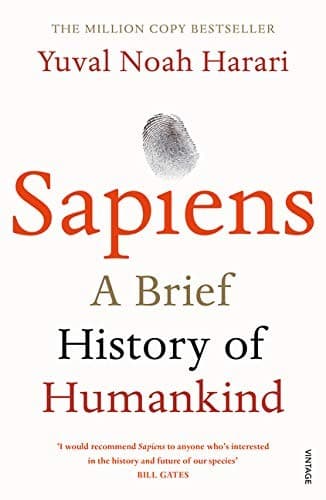
Sapiens
by Yuval Noah Harari · Published 2011
A book that changes how you look at history more than it recounts it. Its greatest value is in tying together religion, the state, money and human cooperation into a single argument.
What works
- Exceptional ability to connect disparate historical developments.
- Makes macro-history accessible.
- Changes how you think about institutions.
- Extremely memorable concepts.
What doesn't
- Historical complexity is sometimes compressed too aggressively.
- Some claims are debated by historians and anthropologists.
- The narrative can be more persuasive than rigorous.
Summary
Sapiens compresses seventy thousand years of our species into a single narrative, but its central question is not historical: what allowed Homo sapiens to dominate the planet when at least five other human species existed, some of them stronger and larger-brained than us? Harari's answer has nothing to do with individual capability. It has to do with the ability to cooperate at very large scale.
The book is organised around three revolutions: the Cognitive Revolution (roughly 70,000 years ago), the Agricultural Revolution (roughly 12,000 years ago) and the Scientific Revolution (roughly 500 years ago). Each is treated not as a technological change but as a redefinition of how humans live, what they believe, and who they are willing to stand beside.
What separates this from a general history is its insistence on one idea: most of what we take to be real — money, nations, corporations, human rights, law — does not exist in nature. They are stories that very large numbers of people have agreed on. Harari calls these imagined orders, and argues that this capacity for collective belief in things that do not exist is the decisive difference between us and every other species.
Key ideas
1. The Cognitive Revolution: the power of fiction
Harari locates the decisive leap in language, not in tools. Unlike other animal communication systems, Sapiens language could describe things that do not exist at all. A chimpanzee can warn its group that a lion is near; it cannot say that the lion is our tribe's guardian spirit.
The distinction sounds trivial and its practical consequence is decisive. Groups organised around personal acquaintance hit a ceiling somewhere around a hundred and fifty people; beyond that, cohesion fails. But if thousands of people believe a shared story — a god, an ancestor, a flag — they can cooperate without ever having met. Armies, religions and states all ride on that one mechanism.
2. Imagined orders
Money is the book's clearest example. A banknote has no intrinsic value; it is paper that works only as long as everyone believes everyone else will accept it. Harari extends the same analysis to joint-stock companies, national borders and legal systems: none has an external referent, and none is any less powerful for that.
There are no gods in the universe, no nations, no money, no human rights, no laws, and no justice outside the common imagination of human beings.
The subtlety is that Harari does not call these orders lies. They are inter-subjective realities: not located in one person's mind but in the belief network of millions, which is exactly why one person's argument cannot dissolve them. This reading makes institutional behaviour more tractable than any individual-level explanation does.
Harari's standing example for this is Peugeot. Peugeot is not a building, not a car, not even a person; it is a "legal fiction" — a story that lawyers and the French state have agreed to treat as real. If every factory burned down, every employee died, and its owner went bankrupt, Peugeot could still legally exist — because what exists was never an object to begin with, but a recognised collective fiction. Harari treats this exact mechanism as the foundation of the entire modern capitalist system.
3. The Agricultural Revolution: "history's biggest fraud"
This is the book's most contested chapter. The conventional account treats farming as the advance that rescued humanity from hunger. Harari argues that for the individual farmer roughly the opposite happened: a narrower diet, longer working hours, new diseases, and an exposure to drought that foragers had not faced.
His argument is that we measure success by the wrong unit. Wheat was extraordinarily successful in evolutionary terms — it went from a regional grass to one of the most widespread plants on earth — but that was wheat's success, not necessarily the success of the people. His well-known formulation is that we did not domesticate wheat; wheat domesticated us. Separating species success from individual welfare is an analytical tool that transfers well beyond agriculture.
4. The Scientific Revolution: the admission of ignorance
On Harari's account, modern science began not with a discovery but with an admission: that we do not know. Earlier traditions assumed all important knowledge was already contained in sacred texts, leaving interpretation rather than discovery as the scholar's job. The decisive shift was making ignorance official.
He then shows how that admission became entangled with two other forces: empire, which funded exploration, and capitalism, which turned research into an investment against future returns. Science, empire and capital form a self-reinforcing loop in his telling — and that loop is what distinguishes the last five hundred years from every period before it.
5. The suffering of domesticated animals: "history's biggest crime"?
One of the book's most contested chapters, quoted less often than the agriculture chapter but no less consequential, examines the relationship between humans and domesticated animals. Harari argues that the domestication of cattle, chickens and pigs was, from the animals' own perspective, an unprecedented catastrophe: separating newborns from mothers, restricting movement to cramped cages, and breeding lines whose bodies trade permanent suffering for higher yield.
He treats this not as a digression but as a direct continuation of the imagined-order argument: the stories we have built about humanity's inherent superiority over animals have no external existence either, exactly like the story of money or the corporation — but they have a very real, measurable consequence for billions of living creatures. His line calling domestication "perhaps history's biggest crime" is deliberately designed to pull the reader out of an assumption we treat as self-evident.
6. Did any of it make us happier?
The book closes on a question most histories avoid: did all this progress improve human lives? Harari gives no clean answer, and this is where he is most honest. Our collective power has grown without precedent, but the evidence that individual satisfaction rose with it is weak.
Who it's for
- Anyone trying to understand institutions — the imagined-order framework is the best thing the book gives you, and it works equally on money, companies, brands and states.
- Anyone who finds history boring — this is not a history of events but a history of ideas; there are no dates to memorise.
- Anyone working in business or product — the argument about collective belief runs directly into why a brand or a currency is worth something only while people believe in it.
- Anyone looking for an entry point — as a first book of macro-history it is more readable than almost any alternative.
FAQ
How does it differ from Homo Deus and Nexus?
Sapiens looks backward, Homo Deus forward, and Nexus at information networks. If you are reading only one, start here: the other two are built on the framework this book constructs, and without it half of their argument hangs in mid-air.
Do I need any background in history?
None at all. The book is deliberately written for a general reader and assumes no prerequisites. If you have studied history you may spot the simplifications sooner, which is an advantage rather than an obstacle.
Are its claims scientific?
Some are, some are interpretation, and the book does not always separate the two. The archaeological and evolutionary-biology material has a real basis; the conclusions about happiness, meaning and the consciousness of prehistoric humans are inherently unprovable. Distinguishing the two layers is left to the reader.
Why is the agriculture chapter so contested?
Because it changes the unit of measurement. Judged by population size, farming is an enormous victory; judged by an individual's quality of life, it is a regression. Critics argue that Harari reads the health and nutrition evidence selectively in order to foreground the second reading.
Is the chapter on domesticated animals a serious part of the book, or a digression?
Serious. It may surprise a reader expecting a purely human history, but Harari treats it as the logical extension of the same framework he applies to money and the state — questioning a boundary we assume is natural.
What actually stays with you?
The habit of asking who agreed to this. After this book it is hard to look at money, a company, a credential or a border and treat it as natural. That shift in attention — not the historical detail — is what remains years later.
Was this useful?
Counts appear once there are 5 votes.