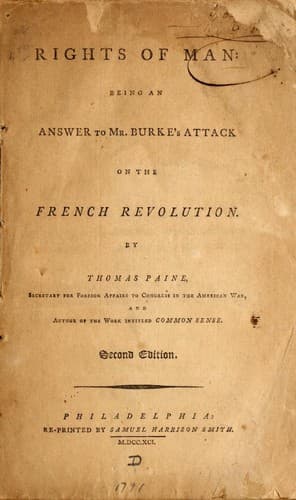
Rights of Man
by Thomas Paine · Published 1791
A political and historical work that takes natural rights and the legitimacy of government seriously. Some of its arguments belong to its own era, but the central idea still holds up.
What works
- Clear political argument.
- Historically important.
- Strong defense of individual rights.
- Useful for understanding modern liberal political thought.
What doesn't
- Strongly tied to its historical context.
- Some arguments feel dated.
- More political polemic than systematic political philosophy.
Summary
Thomas Paine wrote Rights of Man in 1791 as a direct response to Edmund Burke's Reflections on the Revolution in France (1790). Burke had defended tradition, hereditary hierarchy, and the stability of old institutions, describing the French Revolution as a threat to social order. Paine, who himself had played an active role in both the American and French revolutions, argues in response that political authority shouldn't come from hereditary privilege or tradition, but should derive directly from the natural rights of the people.
In the book's first part, Paine draws a distinction between "natural rights" — rights a person holds simply by virtue of existing, like the right to think or the right of conscience — and "civil rights," which are constructed through the social contract to better secure those same natural rights. His argument is that government derives its legitimacy from the consent of the people, not from tradition or family inheritance, and that no government has the right to restrict its citizens' natural rights except with their own explicit consent.
The book's second part, published a year later, moves beyond theoretical critique into specific policy proposals — including a plan for progressive taxation, old-age pensions, and family allowances for children, proposals that were sharply radical for their time and today bear a striking resemblance to the foundations of the modern welfare state.
Key ideas
1. A response to Edmund Burke
The book's entire structure is built around refuting Burke's arguments. Burke argued that rights and political institutions should arise from tradition and historical experience, not abstract principles, and saw the French Revolution as a dangerous break from that tradition. Paine argues the opposite: tradition can't be a source of political legitimacy, because tradition simply means repeating the decisions of past generations — and no generation has the right to bind future generations to its own decisions.
2. The distinction between natural rights and civil rights
Paine treats natural rights as rights a person holds from the moment of existence — the right to think, to conscience, to express opinion. Civil rights, by contrast, are the category of rights constructed through the social contract to better secure those same natural rights — like the right to legal recourse. His key point is that government must not replace or restrict natural rights; government's job is simply to better guarantee the enforcement of rights that already exist.
3. The critique of hereditary government
One of the sharpest and most memorable parts of the book is Paine's critique of hereditary government. He argues that a king's child having a claim to rule simply by birth is exactly as meaningless as claiming that a mathematician's or a poet's child will be skilled in the same profession purely by blood inheritance. In his view, fitness to govern should be judged through the people's free choice, not the accident of birth.
4. Every generation's right to govern itself
Paine argues that no parliament or generation has the right to pass a law that binds future generations forever — because that amounts to the dead governing the living. He calls this "the vanity and presumption of governing beyond the grave," and argues that every generation must be free to redefine its own laws and institutions according to its own needs.
5. The welfare proposals of Part Two
In the book's second part, Paine moves from abstract rights theory to concrete policy proposals: progressive income tax, old-age pensions, financial assistance for families with children, and free education. These proposals, nearly unheard of in their own time, make Paine one of the intellectual forerunners of the modern welfare state — though he himself never used that term.
Who it's for
- Anyone interested in the intellectual history of human rights and liberal political thought — this book is one of the foundational texts of that tradition.
- Anyone who wants to read the core arguments for consent-based government from the primary source — not secondhand summaries.
- Anyone interested in the historical Burke–Paine debate over the French Revolution — reading this alongside Burke's Reflections gives a fuller picture of that debate.
- Anyone looking for a systematic, contemporary philosophical analysis of human rights — the book is more political polemic born of a specific historical moment than formal, abstract political philosophy.
FAQ
What work was this book responding to?
It was a direct response to Edmund Burke's Reflections on the Revolution in France (1790), in which Burke defended tradition and the stability of hereditary institutions and described the French Revolution as dangerous.
What's the difference between natural rights and civil rights in this book?
Natural rights are rights a person holds from the moment of existence (like the right to think); civil rights are constructed through the social contract to better secure those same natural rights. Government must not replace or restrict natural rights.
Why was Paine opposed to hereditary government?
He argued that fitness to govern can't simply be transmitted by birth; competence should be judged through the people's free choice, not the accident of birth.
What were Paine's welfare proposals in Part Two?
Progressive taxation, old-age pensions, financial assistance for families with children, and free education — proposals unheard of in their time that today closely resemble the foundations of the modern welfare state.
Does this book still matter in today's debates?
Its central idea — that government's legitimacy comes from the people's consent, not tradition or hereditary privilege — is still referenced in political debates today, though some of the book's specific arguments are bound to their own particular historical context.
Was this useful?
Counts appear once there are 5 votes.