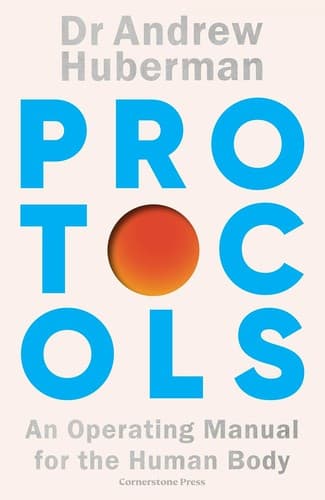
Protocols
by Andrew Huberman · Published 2025
A practical collection of advice on sleep, focus, exercise and daily performance. Useful for turning scientific concepts into workable habits — though its recommendations are best weighed against the quality of the underlying evidence rather than taken as settled prescription.
What works
- Highly practical.
- Connects behavior with neuroscience and physiology.
- Useful for experimenting with routines.
- Organized around actionable protocols.
What doesn't
- Not every recommendation has equally strong evidence.
- Can encourage an overly optimized approach to everyday life.
- Scientific nuance can get lost when translated into protocols.
- Better viewed as a starting point than a medical authority.
Summary
Andrew Huberman, a neuroscience professor at Stanford and host of the popular Huberman Lab podcast, wrote Protocols to gather years of scattered podcast content into one coherent, practical guide. Unlike many general neuroscience books that mostly stick to theoretical explanation, this book is organized around the "protocol" — a specific, actionable instruction set for domains like sleep, focus, exercise, stress, and nutrition.
The book's structure is topic-driven: each chapter picks a specific area of daily functioning, briefly explains its scientific basis (usually grounded in physiological mechanisms like circadian rhythm, dopamine, or the autonomic nervous system), and then arrives at one or more specific, actionable steps the reader can try in everyday life.
The book's implicit message is that many aspects of physiological and cognitive performance — usually treated as fixed or genetically determined traits — are actually significantly influenced by adjustable daily behaviors: when you're exposed to light, when you sleep, your exercise pattern, and even the timing of caffeine intake. Huberman presents these protocols not as definitive medical prescription, but as a starting point for personal experimentation.
Key ideas
1. Morning light and setting the circadian rhythm
One of the book's central protocols is the recommendation to view natural sunlight within the first 30 to 60 minutes of waking. Huberman explains that this helps set the timing of cortisol and melatonin release — improving morning alertness and making nighttime sleep more predictable. His practical note is that this doesn't require staring directly at the sun, and even on a cloudy day, being outdoors is still largely effective.
2. Non-Sleep Deep Rest (NSDR)
Huberman introduces a protocol called Non-Sleep Deep Rest, drawn from the traditional practice of yoga nidra: short 10-to-20-minute periods of guided, sleep-free relaxation done during the day, especially after a midday dip in focus. He argues this practice can offset part of a sleep deficit and reset dopamine levels for better focus later in the day.
3. The 90-minute ultradian rhythm for focus
One of the book's practical protocols is based on the body's ultradian rhythm — roughly 90-minute natural cycles in alertness and energy. Huberman's recommendation is to design focused work blocks around that same window and, instead of forcing yourself to continue after a natural dip in concentration, take a short break. This protocol tries to align deep work with the body's natural rhythm rather than fighting against it.
4. Cold exposure for alertness and dopamine
One of the book's well-known protocols is deliberate exposure to intense cold (like a cold shower or ice bath). Huberman explains that this can raise sustained dopamine levels for hours afterward, boosting alertness and motivation. He stresses that the duration and intensity of exposure should be calibrated to individual tolerance, and this protocol isn't a substitute for medical advice for people with specific cardiovascular conditions.
5. Delaying caffeine after waking
Huberman recommends delaying caffeine intake by 90 to 120 minutes after waking. His physiological explanation is that immediately after waking, adenosine levels (caffeine's target) are still low, and early caffeine intake can lead to a more severe energy crash later in the day; delaying it, in his account, makes the daily energy curve more stable.
Who it's for
- Anyone who wants to turn scientific concepts into practical daily habits — the book's protocol-driven structure is built exactly for that.
- Anyone looking to improve sleep, focus, or daily energy — most protocols are simple, low-cost, and require no special equipment.
- Anyone looking for definitive or personalized medical advice — this book isn't a substitute for medical consultation, and its recommendations are general.
- Anyone sensitive to the scientific certainty behind each recommendation — it's worth noting that the evidence behind every protocol isn't equally strong.
FAQ
Is this book a substitute for medical advice?
No. The book's protocols are general recommendations, and anyone with a specific medical condition (especially for protocols like cold exposure) should consult a doctor first.
Why does morning light matter so much in the book?
Because viewing natural light early in the day helps set the timing of cortisol and melatonin release, which improves both daytime alertness and nighttime sleep quality.
What is Non-Sleep Deep Rest (NSDR)?
Short periods of guided relaxation, drawn from yoga nidra, used during the day to offset part of a sleep deficit and reset focus.
Are all of the book's recommendations equally well-supported?
No. Some protocols rest on stronger scientific evidence, while others are more inferential or based on more limited experience. It's recommended to treat the book as a starting point for personal experimentation, not a final scientific authority.
Why should caffeine intake be delayed?
Because immediately after waking, adenosine levels are still low, and early caffeine intake can lead to a more severe energy crash later in the day; delaying it by 90 to 120 minutes makes the energy curve more stable.
Was this useful?
Counts appear once there are 5 votes.