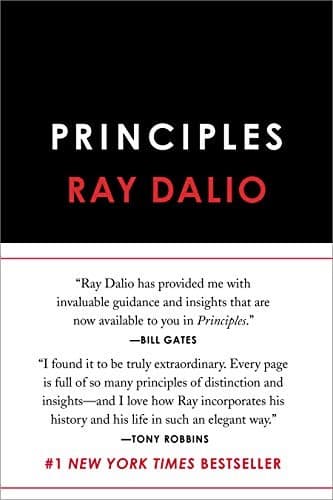
Principles
by Ray Dalio · Published 2017
Better decisions come from turning experience into explicit principles and using them as repeatable decision-making systems.
What works
- Strong emphasis on systematic thinking.
- Useful management concepts.
- Encourages learning from mistakes.
- Interesting approach to organizational decision-making.
What doesn't
- Strongly shaped by Dalio's personal worldview.
- Radical transparency isn't appropriate everywhere.
- Can make human organizations seem overly mechanical.
As an affiliate, I may earn a small commission if you buy through this link — at no extra cost to you.
Summary
Ray Dalio, founder of Bridgewater Associates — one of the world's largest hedge funds — wrote Principles out of four decades of experience building and running a large financial organization. The book's central claim is that better decisions come from turning experience into explicit, written principles — rules applied again and again in similar situations, instead of reacting emotionally in the moment.
The book is organized into three parts: the first is Dalio's personal memoir and the path that shaped his philosophy; the second covers life principles (his view of reality, making mistakes, decision-making); and the third — which makes up much of the book's bulk — details his work and management principles, including how he builds organizational culture, hiring, performance evaluation, and collective decision-making.
The backbone of Dalio's philosophy is a concept he calls "radical transparency" and "radical truth": the belief that the best decisions get made when everyone, regardless of hierarchical position, can freely voice opinions, offer criticism, and raise disagreement openly — provided that process runs on clear, credibility-tested rules, not unstructured chaos.
Key ideas
1. Radical transparency and radical truth
Dalio believes most organizations make worse decisions because people are afraid to voice their real opinions — especially criticism directed at those above them. His solution is that nearly all information (barring genuinely confidential matters) should be accessible to every member of the organization, and people should be encouraged to raise disagreements and criticism directly and openly, even toward senior leaders. The goal isn't to license rudeness — it's to identify and fix problems and mistakes as quickly as possible, before secrecy lets them grow bigger.
2. Believability-weighted decision making
Dalio rounds out radical transparency with the concept of "believability-weighted decision making": not everyone's opinion carries equal weight in a decision. Someone with a track record of good decisions in a specific domain should carry more weight in decisions within that same domain, independent of their formal position in the organization. This idea tries to strike a systematic balance between two extremes — "only the boss decides" and "everyone gets an equal vote."
3. The Dot Collector
One of the strangest and most concrete tools Dalio implemented at Bridgewater was an app called the Dot Collector — a tool that, during meetings, lets employees rate a colleague's performance or behavior (including senior managers') in real time, on dimensions like "openness" or "logical reasoning." This data accumulates over time and builds each person's "believability" profile across different domains — exactly the data later used in believability-weighted decision-making.
4. The "Pain + Reflection = Progress" formula
Dalio sums up one of the book's central rules in a short equation: pain plus reflection equals progress. His belief is that most real growth, for individuals and organizations alike, comes out of painful moments — failure, a major mistake, a crisis — but only if that pain is paired with honest, written reflection, not just endured and forgotten. He encourages Bridgewater employees to log their mistakes in an "issue log" so recurring patterns can be identified.
5. The five-step process for achieving a goal
Dalio proposes a practical framework for achieving any goal: clearly setting the goal, identifying the problems standing in its way, diagnosing the root cause of those problems, designing a solution, and finally, doing it. His key point is that most people and organizations fail at the root-cause diagnosis step — because instead of honestly digging into the real cause of a problem, they jump straight to a solution and end up repeating the same mistake.
Who it's for
- Managers and organizational leaders looking for a systematic decision-making framework — the book offers concrete tools and principles for building organizational culture.
- Anyone who wants to systematically learn from their own and others' mistakes — the "Pain + Reflection = Progress" formula gives a practical framework for that.
- Anyone working in a traditionally hierarchical organization looking for an alternative model — radical transparency offers a genuinely different perspective.
- Anyone working in an environment built on subtle, informal human relationships — Dalio's approach can be challenging for organizational cultures that are less direct or more socially considerate.
FAQ
What exactly does "radical transparency" mean?
It means most organizational information is accessible to everyone, and people are encouraged to raise criticism and disagreements, even toward senior managers, directly and openly — aimed at identifying problems faster, not licensing rudeness.
What tool is the "Dot Collector"?
It's an app used at Bridgewater that lets employees rate colleagues' performance in real time during meetings; that data builds each person's "believability" profile across different domains.
Are these principles applicable to every organization?
Not necessarily in the exact same form. These principles were shaped by Bridgewater's own specific organizational culture, and some of them (especially radical transparency) need serious adaptation for other organizational cultures.
How does the "Pain + Reflection = Progress" formula work in practice?
Dalio recommends logging mistakes and failures in writing and, instead of quickly forgetting them, identifying recurring patterns — it's that honest reflection that turns the pain of an experience into real growth.
Why do some critics take issue with Bridgewater's culture?
Some former employees have described Bridgewater's work environment as stressful and excessively monitored, and argue that the level of radical transparency described in the book can, in practice, impose significant psychological pressure on employees.
Was this useful?
Counts appear once there are 5 votes.