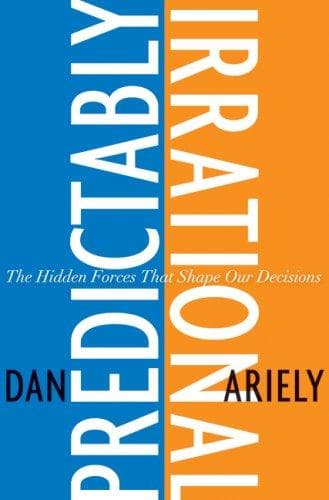
Predictably Irrational
by Dan Ariely · Published 2008
Human irrationality isn't random; many of our seemingly irrational decisions follow recurring patterns.
What works
- Accessible introduction to behavioral economics.
- Interesting experiments.
- Useful for understanding consumer behavior.
- Connects psychology with economics.
What doesn't
- Some of Ariely's research has faced serious credibility concerns.
- Some findings are presented more confidently than warranted.
- Better as an introduction than as definitive behavioral science.
As an affiliate, I may earn a small commission if you buy through this link — at no extra cost to you.
Summary
In Predictably Irrational, Dan Ariely challenges the foundational assumption of classical economics: that humans are rational decision-makers who always act in their own self-interest. His argument isn't simply that people sometimes make mistakes. His sharper, more interesting claim is that these mistakes aren't random — they follow systematic, predictable patterns. That's why the book is called "predictably" irrational, not just "irrational."
Ariely backs this claim not with theoretical argument but with dozens of behavioral experiments he and his collaborators designed, both in the lab and in the real world. Each chapter revolves around a specific cognitive bias — from the anchoring effect to the deep difference in how people behave toward "free" versus "almost free," from the clash between social norms and market norms to the power of expectation in the actual physical experience of pain and pleasure.
The book's central message for the reader is that if these patterns of irrationality are predictable, then environment design, pricing, and personal decision-making can all be improved by understanding those exact patterns — not by trying to become "more rational" in some abstract sense, but by precisely recognizing the traps the human mind systematically falls into.
Key ideas
1. The relativity effect and the Economist subscription experiment
One of the book's most famous examples is an experiment Ariely ran using a real subscription ad for The Economist: three options — web-only for $59, print-only for $125, and print-plus-web also for $125. The second option (print-only, at the same price as the third) looks pointless at first glance, since nobody chooses it — but its presence makes the third option look far more attractive. When Ariely removed that "useless" option, the majority's choice shifted dramatically from the more expensive option to the cheaper one — showing that our decisions are rarely absolute; they're judged relative to the options around them.
2. The anchoring effect and the social security number experiment
In another of the book's well-known experiments, Ariely asked participants to write down the last two digits of their social security number, then state the highest price they'd be willing to pay for items like wine or a keyboard. Participants whose last two digits were higher (close to 99) systematically bid higher prices than those whose digits were lower — even though that number was completely unrelated to the items' actual value. The experiment shows how a purely random number can act as an "anchor" and shape subsequent judgment.
3. The power of "free"
In one of his simplest but most telling experiments, Ariely let participants choose between a luxury Lindt truffle for 15 cents and an ordinary Hershey's Kiss for 1 cent; most chose the truffle. But when he lowered both prices by exactly the same amount (truffle to 14 cents, Hershey's Kiss to zero — free), even though the relative price gap between the two options stayed exactly the same, a large majority swung toward the free option. His conclusion is that "free" is an entirely separate psychological category, not simply the lowest point on a price axis.
4. The clash between social norms and market norms
Ariely shows that people live under two separate systems of norms: social norms (helping a neighbor, hospitality), which run on reciprocity without precise financial calculation, and market norms (wages, prices, deals), which are entirely calculating. His key point is that once cash enters a social relationship — even a small amount — the entire relationship collapses from social norms into market norms, and often the original motivation to help disappears; offering someone a small payment for a task they were doing voluntarily, for instance, usually makes them less willing to do it, not more.
5. Expectation and the real experience of pain
In one of the book's most striking experiments, Ariely gave participants a placebo painkiller, telling some it cost $2.50 per pill and others it cost only 10 cents. Both groups received the exact same electric shock, but the group who believed they'd taken the more expensive drug reported significantly greater pain relief — even though both drugs were completely inert. Ariely concludes from this that expectation isn't just a subjective perception layered on top — it's a real part of the actual physical experience of pain and pleasure.
Who it's for
- Anyone newly interested in behavioral economics — the book introduces the field's core concepts without technical jargon, through concrete experiments.
- Product designers and marketers — experiments like the relativity effect and the power of "free" connect directly to pricing design and how options are presented.
- Anyone looking for entirely settled, uncontested scientific findings — some of Ariely's later research has faced serious credibility concerns and should be read with that awareness.
- Anyone looking for a formal, mathematical decision-making framework — the book is narrative- and experiment-driven, not a formal behavioral-economics text with precise formulations.
FAQ
What exactly does "predictably irrational" mean?
It means humans' irrational decisions aren't random — they follow fixed, predictable patterns, the same patterns Ariely shows through experiments repeating again and again across different groups.
Why did the Economist subscription experiment become so famous?
Because it shows, with total simplicity, how a seemingly useless option on a menu can shift the majority's buying behavior, without people even realizing they were influenced by that option.
Has the scientific validity of these experiments been questioned?
Some of Ariely's later research (not necessarily the studies in this book) has faced serious concerns about data integrity. It's recommended to read the book with the same critical eye you'd apply to any other scientific finding.
Why does "free" affect decision-making so strongly?
Because, in Ariely's account, "free" is a separate mental category, not simply the zero point on a price axis — the perceived risk of loss drops to zero, and that sense of being risk-free inflates its appeal out of proportion to its actual value.
What's the practical use of this book in everyday life?
Awareness of these biases helps a reader be more alert in financial decisions, negotiation, and pricing — for example, understanding why a "decoy" option on a menu might be steering their choice, or why introducing money as payment into a friendly relationship can weaken that relationship.
Was this useful?
Counts appear once there are 5 votes.