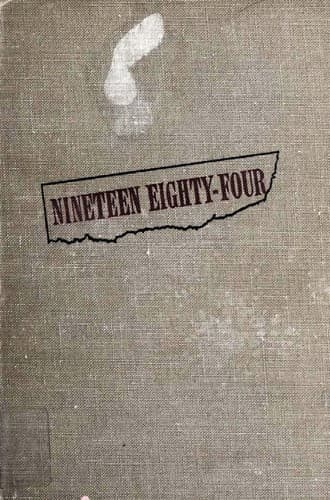
Nineteen Eighty-Four
by George Orwell · Published 1949
When a system controls language, information, memory and the boundaries of acceptable thought, controlling people's perception of reality becomes possible.
What works
- Exceptional political dystopia.
- Powerful analysis of propaganda and surveillance.
- Deep exploration of language and truth.
- Remains culturally relevant.
What doesn't
- Extremely bleak.
- Can be reduced to simplistic political interpretations.
- Some readers focus too much on surveillance and miss the deeper ideas about truth and language.
As an affiliate, I may earn a small commission if you buy through this link — at no extra cost to you.
Summary
Nineteen Eighty-Four is not a prediction of a specific year but the mechanism of a totalitarian system pursued to its logical end. Orwell draws Oceania: a state run under the slogan "War is Peace, Freedom is Slavery, Ignorance is Strength," which targets not just behaviour but the very ability to think of alternatives. Winston Smith, a clerk at the Ministry of Truth whose job is falsifying historical records, gradually rebels against that system — first in his mind, then in a forbidden diary, and finally in a secret relationship with Julia.
What separates this from an ordinary political novel is its focus on language and mind, not just secret police and torture. The Party controls not only people's behaviour but reality itself as something thinkable, through a language called Newspeak that loses more words every year, until eventually even thinking the concept of "freedom" becomes linguistically impossible.
The ending — Winston's breaking in Room 101 and his love for Big Brother — is often read as the bleakest ending in twentieth-century literature, but Orwell chose it deliberately: his point was to show that a fully closed system can capture not just the body, but the mind.
Key ideas
1. Newspeak: thought control through the elimination of language
Newspeak is not a manipulation of existing language but its complete replacement with a system that shrinks every year. The Party's official goal is explicit: by 2050 there should be no word left to express concepts like "political freedom" or "equality" — not because these ideas are forbidden, but because no language remains to think them with. Orwell calls this thoughtcrime: a crime made fundamentally impossible by erasing the tool needed to think it.
2. Doublethink
Doublethink is the ability to hold two contradictory beliefs in mind simultaneously and accept both as true — knowing, for instance, that the Ministry of Peace wages war and the Ministry of Truth fabricates lies, while at the same moment believing these ministries do exactly what their names say. This mechanism goes beyond ordinary lying; a liar knows they're lying, but the doublethinker holds the contradiction unresolved in mind without registering it as a contradiction at all.
War is Peace. Freedom is Slavery. Ignorance is Strength.
3. Telescreens and constant surveillance
Every home, office and street in Oceania has a telescreen — a device that simultaneously broadcasts propaganda and records every movement and sound, and never turns off. The key psychological point is that no one knows for certain whether they're being watched at any given moment; it's this uncertainty, not actual surveillance, that controls behaviour. People act as though they are always seen, because the possibility always exists.
4. Controlling the past: "who controls the past controls the future"
Winston's job at the Ministry of Truth is rewriting old newspapers so they match the Party's newest predictions or announcements. If the Party had predicted increased chocolate production and it didn't happen, the historical record is rewritten to show the Party had predicted a reduction all along. Orwell shows here that controlling history is even more powerful than controlling the present: if no independent record of the past survives, "truth" becomes simply whatever the Party announces today.
5. Room 101: personalised fear
Room 101 is where every prisoner confronts "the worst thing in the world" — which is different for each person. For Winston, it is rats. The Party doesn't just torture him; it knows exactly what his deepest personal fear is and uses it to break his loyalty to Julia — not to force a confession, but to make him genuinely, wholeheartedly wish that Julia be tortured in his place. This moment is the peak of Orwell's argument: the Party doesn't just want outward compliance, it wants real, voluntary love for Big Brother.
Who it's for
- Anyone who wants to understand language and power — the Newspeak argument gives a framework that applies beyond the story, to real censorship and propaganda.
- Anyone interested in history and collective memory — the argument about controlling the past is exactly what historians mean by "history written by the victors," in narrative form.
- Anyone reading dystopian fiction — this is the genre's primary reference point; Brave New World and many later works respond to it directly or indirectly.
- Anyone who can tolerate a completely bleak ending — this is not a good choice for a reader looking for hope at the finish.
FAQ
Is this book about state surveillance, or something deeper?
Deeper. Surveillance is a means, not the end goal. The Party's real objective is mind control complete enough that constant surveillance becomes unnecessary — once doublethink is internalised, the individual becomes their own thought-censor.
Why is it called "1984" when it doesn't predict a specific year?
Orwell wrote the book in 1948 and apparently just transposed the last two digits. The number itself isn't the point; even within the text it isn't clear Winston really knows what year it is, because the Party has taken that certainty from him too.
How does it differ from Brave New World?
Orwell shows control through pain and fear; Huxley shows control through pleasure and comfort. The real question isn't which author predicted more accurately, but which mechanism is more visible in your own society.
What does the ending mean?
It offers no hopeful message, and Orwell wanted exactly that. Winston's total breaking shows that a fully closed system, with no external source of truth, can rebuild even the deepest human loyalties from the ground up.
Are its terms still in use?
Yes, unusually so. "Big Brother," "Thought Police," "doublethink" and "Room 101" have become part of everyday political vocabulary in many languages — a sign that the book built a framework that has outlasted its own story.
Was this useful?
Counts appear once there are 5 votes.