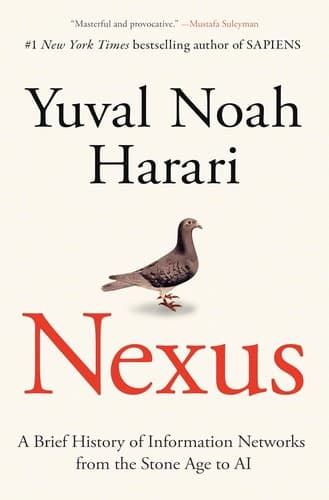
Nexus
by Yuval Noah Harari · Published 2024
An interesting look at the relationship between information, networks, power and AI. The ideas are compelling, but as in some of Harari's other work, the narrative occasionally runs ahead of the evidence.
What works
- Interesting connection between information and power.
- Relevant to AI.
- Strong historical perspective.
- Raises important questions about information systems.
What doesn't
- Broad rather than deep.
- Some historical arguments are debatable.
- Occasionally makes complex systems feel simpler than they are.
- Less impactful than Sapiens for me.
Summary
In Nexus, Yuval Noah Harari steps back from the sweeping, all-of-human-history pattern of Sapiens, Homo Deus, and 21 Lessons for the 21st Century and narrows in on a single thread: the history of information networks, from Stone Age mythology to today's AI. His central claim is that human dominance doesn't come from superior individual intelligence but from the ability to cooperate at massive scale — and that cooperation is only possible through information networks: myth, religion, bureaucracy, money, and now algorithms.
Harari draws a line between two common views of information. The "naive view" holds that more information automatically leads to more truth and more wisdom. The "populist view" treats information as nothing but a tool of power, with truth barely relevant. His own claim splits the difference: information's power doesn't necessarily come from being true. Information can build networks, create institutions, and enable collective action without being accurate — sometimes precisely because it's simple, decisive, or emotionally resonant rather than because it captures reality carefully.
The book's arc runs from oral mythmaking and the formation of official religious canon, through bureaucratic, paperwork-driven states, to today's algorithmic networks. Harari's closing question is this: for the first time in history, the nodes of an information network — AI systems — can act, decide, and even "negotiate" with each other independent of human oversight. What does that mean for the future of the very networks human civilization is built on?
Key ideas
1. Information's power doesn't come from being true
The book's central thesis is that the relationship between information and truth isn't the direct one people usually assume. Against the "naive view" (more information equals better understanding of reality) and the "populist view" (information is just a power tool, truth barely matters), Harari stakes out a third position: information is usually used to build order — connecting people, shaping institutions, coordinating collective action — and that function is sometimes aligned with accuracy and sometimes entirely independent of it. A simple, decisive myth can unite millions of people under a shared order precisely because it ignores the complications of reality.
2. The printing press and witch-hunting manuals
To show that greater access to information doesn't automatically lead to more truth, Harari points to a concrete historical case: after the invention of print, one of the best-selling book genres in Europe was witch-hunting manuals — including the Malleus Maleficarum ("Hammer of Witches"), which spread and reproduced at an unprecedented rate thanks to that same new technology. Rather than clearing away superstition, the new information technology helped it spread faster and more systematically — because what print guarantees is faster distribution, not a filter for accuracy.
3. Bureaucracy as an information technology
One of the book's less obvious ideas is that paperwork and bureaucracy shouldn't be seen merely as administrative obstacles — they should be treated as an information technology in their own right, on par with print or the internet. Filing, classification, archiving, and regular reporting let large institutions, from the Catholic Church to modern states, coordinate millions of people who have never met each other into a single order. Harari argues that large-scale social control throughout history has usually been exercised not through direct violence but through this seemingly dry information infrastructure.
4. Self-correcting mechanisms
Against the risk that information networks can easily become tools of suppression or delusion, Harari points to mechanisms that make some networks more resilient to their own errors: peer review in science, the separation of powers and a free press in democracy. The key difference between these institutions and a totalitarian system isn't that they don't make mistakes — it's that they have formal channels for identifying and correcting them. In his view, the long-term health of any information network depends on the presence of these self-correcting mechanisms, not on the sheer volume of information flowing through it.
5. AI as the first independent member of the network
Harari's distinguishing claim about AI isn't that it's a new technology — it's that for the first time, a member of an information network can make decisions, generate content, and even "interact" with other nodes without direct human involvement. He points to events like the 2010 stock market "flash crash," in which trading algorithms, acting independently of any real-time human decision, wiped out billions of dollars in market value within minutes — a small-scale preview of what can happen once network nodes are no longer simply tools in human hands.
Who it's for
- Anyone who's read Sapiens or Homo Deus and wants Harari's take on AI — this book directly extends that same framework to information and algorithms.
- Anyone interested in technology policy and AI governance — the "information networks" framework offers a useful historical angle on these debates.
- Anyone looking for a rigorous, technical analysis of AI itself — this is a work of history and philosophy of information, not a book about machine-learning model architecture.
- Anyone who dislikes sweeping, occasionally contentious historical argument — Harari's style, as in his earlier books, favors broad narrative over narrowly bounded case analysis.
FAQ
Do I need to have read Sapiens before this book?
No, Nexus stands on its own. But a reader already familiar with Harari's framework around shared stories and human cooperation will find it easier to see how this book connects to his earlier work.
Is this book about AI or about history?
Both, with more weight on history. Roughly two-thirds of the book covers pre-industrial and industrial information networks (myth, religion, bureaucracy); the final section connects that framework to AI and its future.
Why is its rating lower than Sapiens?
Because it lacks some of the intellectual novelty of Sapiens, and some of its historical arguments are broader and less tightly documented than that book's. For a reader familiar with Harari's style, this book is a logical extension of the same ideas rather than a fresh leap.
Does the book land on an optimistic or pessimistic conclusion about AI?
Not exactly either. Harari avoids a firm prediction and instead raises questions about self-correcting mechanisms: can today's societies build the same kind of control institutions for algorithmic networks that they built for democracy and science?
Do I need prior technical knowledge of AI?
No. The book is written for a general reader and avoids technical detail about algorithms or machine-learning models; its focus is the historical and social consequences of these technologies, not their technical architecture.
Was this useful?
Counts appear once there are 5 votes.