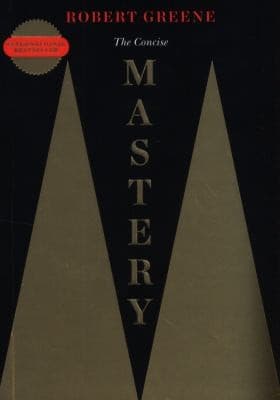
Mastery
by Robert Greene · Published 2012
The central idea is simple but important: real skill is built from years of practice, observation and deep work. The historical sections are compelling, though some of the stories are shaped a little too neatly into a pattern.
What works
- Strong emphasis on long-term skill development.
- Excellent historical examples.
- Encourages patience over quick results.
- Relevant to entrepreneurship and professional development.
What doesn't
- Some historical stories are simplified.
- Can romanticize extreme dedication.
- The framework isn't equally applicable to every profession.
- Occasionally feels repetitive.
Summary
In Mastery, Robert Greene makes a claim that runs against today's culture of instant success: real mastery of a field isn't the product of innate talent or sudden inspiration, but the result of years — usually a decade or more — of deep work, careful observation, and voluntary acceptance of difficulty. He builds this claim not abstractly but through the biographies of dozens of historical and contemporary figures — from da Vinci to Temple Grandin.
The book's structure revolves around three stages Greene treats as recurring across every path to mastery: the apprenticeship phase (where foundational skills are absorbed through observation and practice), the creative-active phase (where a person begins to move beyond the learned rules), and finally mastery itself (where knowledge has become so internalised it turns into intuition).
The book's central message is that this path is available to everyone, not just geniuses — provided a person is willing to endure the early years, which are often tedious and lack immediate external reward.
Key ideas
1. Finding your life's task
Greene argues everyone, usually in childhood, has a natural, hard-to-explain pull toward a particular activity or field — a signal he calls a "life's task." The problem isn't that this inclination doesn't exist; the problem is that social pressure, family expectations, or financial need often divert most people away from following it. The real first step on the path to mastery isn't learning a skill; it's honestly identifying that original pull.
2. The apprenticeship phase: absorption through observation
Greene presents the apprenticeship phase not as something to be endured but as the primary period of building the foundation. He lists several key skills for this period: careful observation before acting, humble practice without shortcuts, and testing knowledge in the real world rather than purely theoretical learning. Greene's subtle point is that the real speed of learning is often inversely related to its apparent speed — someone rushing to look "masterful" sooner usually builds a shakier foundation.
3. Temple Grandin: turning cognitive difference into advantage
One of the book's most compelling examples is Temple Grandin — the autistic scientist who, rather than hiding or fighting her different way of thinking (which she describes as "seeing in pictures" rather than abstract language), channelled it directly into designing livestock handling systems. Her ability to precisely visualise space from the animals' own perspective let her design systems that dramatically reduced livestock stress — something her "neurotypical" colleagues couldn't see the same way. Greene treats this as an example of real mastery sometimes coming not from overcoming difference, but from accepting and specialising in it.
The path to mastery runs through embracing difficulty and repetition, not avoiding them.
4. The mentor dynamic
Greene stresses the importance of finding the right mentor — not necessarily someone perfectly matched to the apprentice's personality, but someone with deep knowledge of the field. The mentor-apprentice relationship, he says, is the fastest way to transfer tacit knowledge: things written in no book, but absorbable through close observation of a master at work. He warns the relationship shouldn't become permanent dependency; eventually, the apprentice must step out of the mentor's shadow.
5. Social intelligence as a complementary skill
Greene emphasises that technical skill alone isn't enough; navigating the politics of an environment — understanding power dynamics, avoiding unnecessary enemies, building alliances — is just as essential for reaching recognised mastery. He gives several examples of talented people who lost major opportunities by ignoring this dimension, despite outstanding technical skill.
Who it's for
- Anyone at the start of a long-term career path — the three-stage framework gives realistic expectations about the time and patience required.
- Anyone who feels they've missed shortcuts to opportunity — the book's historical examples show many masters took non-linear paths.
- An entrepreneur or leader building a team — the apprenticeship and mentor-dynamic material translates directly into talent development.
- Anyone looking for a fast, step-by-step instruction manual — this book gives philosophy and pattern, not a ten-day action plan.
FAQ
How long does it take to reach mastery?
Greene gives no precise number, but the common pattern across his historical examples is usually a decade or more. His emphasis is that this timeline shouldn't be discouraging; the apprenticeship period itself, if navigated correctly, is valuable and meaningful, not just a wait for something better.
Does mastery only apply to creative or intellectual professions?
No, Greene draws examples from very diverse fields — from art and science to business and sport. The underlying principle (observation, practice, gradually moving past the rules) holds in any field requiring deep skill.
Why is the Temple Grandin example so prominent?
Because it shows mastery doesn't necessarily mean fitting into a standard mould. Greene treats it as an example where cognitive difference became the primary tool of expertise, rather than an obstacle — a lesson that applies beyond her specific story.
Do I need a formal mentor?
Not necessarily formally, but Greene emphasises that access to an experienced person's tacit knowledge — whether through a formal mentor or close observation of a master at work — dramatically speeds up learning compared with entirely self-taught learning.
How does this book differ from typical motivational books?
The main difference is its historical depth and the specificity of its three-stage framework. Instead of general "work hard" slogans, it maps a specific path (apprenticeship, creative-active mastery, mastery) documented with dozens of real examples.
Was this useful?
Counts appear once there are 5 votes.