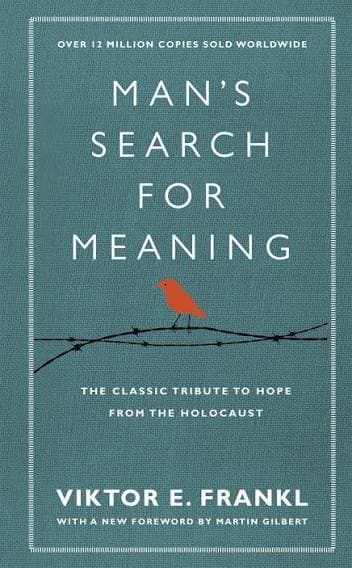
Man's Search for Meaning
by Viktor Frankl · Published 1946
Even when circumstances cannot be controlled, finding meaning can fundamentally change how a person responds to them.
What works
- Powerful connection between psychology and philosophy.
- Deep exploration of meaning and resilience.
- Short but extremely impactful.
- Highly memorable.
What doesn't
- Some psychological conclusions require historical context.
- Frequently reduced to simplistic motivational quotes.
- The historical material is emotionally difficult.
As an affiliate, I may earn a small commission if you buy through this link — at no extra cost to you.
Summary
Man's Search for Meaning is made of two very different parts bound together. The first is the memoir of Viktor Frankl, an Austrian psychiatrist, of three years' imprisonment in Nazi labour camps including Auschwitz — not a comprehensive historical account, but a psychologist's observations on why some prisoners, in conditions where human dignity was systematically stripped away, managed to preserve a healthier inner life while others did not.
The second part is a condensed introduction to logotherapy, Frankl's own school of psychotherapy built on that experience. Unlike Freud, who saw humanity's primary drive as the "will to pleasure," and Adler, who saw it as the "will to power," Frankl argues the primary human drive is the "will to meaning" — and the absence of meaning, not necessarily the absence of pleasure, is the root of much modern psychological suffering.
The link between these two parts is summed up in one line Frankl borrows from Nietzsche: he who has a why to live can bear almost any how. The book doesn't claim suffering is good, and it doesn't claim meaning replaces pain; it claims that even when suffering is unavoidable, how you meet it remains a choice.
Key ideas
1. The last human freedom
The book's most famous idea: even when everything — possessions, health, family, physical freedom — is taken from a person, one thing remains that no one can take: the freedom to choose one's attitude toward what happens to them. Frankl writes this not as a motivational slogan but as a clinical observation — he witnessed that even in the camp, some prisoners retained the ability to choose decent behaviour, in conditions that appeared to leave no choice at all.
2. Three sources of meaning
Frankl treats meaning not as an abstract essence but as something found through three specific paths: work (creating something or accomplishing a task), love (the experience of deep connection with another person), and suffering (the attitude a person adopts toward unavoidable suffering). The third is the most important and most contested part of his theory: even when no work or relationship is available, meaning can still be found in how one bears suffering.
He who has a why to live can bear almost any how.
3. The imaginary lecture: Frankl's technique for psychological survival
Frankl describes that, in the camp's hardest moments, he would imagine himself years later, in a brightly lit hall, lecturing on the psychology of concentration-camp prisoners — the exact suffering he was enduring in that moment. This mental exercise let him step back from his present experience and view it as something that would one day hold meaning and value, rather than simply purposeless pain. He later treated this as a practical example of logotherapy: changing a person's relationship to suffering, not eliminating the suffering itself.
4. Logotherapy versus Freud and Adler
Frankl explicitly positions himself against the two dominant schools of psychoanalysis of his time. Freud saw the "will to pleasure" as the primary drive; Adler saw the "will to power." Frankl argues both are real forces but secondary — a person pursues pleasure or power usually because they have failed to find meaning, not because these are the ultimate goal. Rather than asking "what do you want from life?", logotherapy asks "what does life want from you?" — a shift in the direction of the question Frankl considers fundamental.
5. The existential vacuum and suffering after liberation
Frankl records a bitter observation: many camp survivors, immediately after liberation, experienced not joy but a kind of psychological numbness or even deep depression. His explanation is that the "existential vacuum" — the absence of a clear purpose for the future — can be even more dangerous than direct suffering. This observation became the foundation of his broader concept: in modern societies where acute physical suffering is rarer, the existential vacuum has become one of the most common sources of psychological pain.
Who it's for
- Anyone facing a crisis or suffering they cannot control — not as a magic solution, but as a framework for viewing it.
- Anyone interested in the psychology of meaning and motivation — the primary source of logotherapy and a precursor to much later positive psychology.
- Anyone looking for a short but deeply impactful book — its brevity doesn't make it light.
- Anyone currently in a fragile psychological state — the historical sections are emotionally heavy and should be read with that in mind.
FAQ
Are the camp sections too difficult to read?
For many readers, yes, it's difficult, but Frankl deliberately avoids excessive graphic description and focuses on psychological observation rather than emotional shock. This is a book about suffering, but it wasn't written to put suffering on display.
How does logotherapy differ from today's therapies?
Many modern approaches — particularly Acceptance and Commitment Therapy (ACT) — draw directly on Frankl's ideas. The main difference is that logotherapy explicitly centres "meaning" as the therapeutic goal, not just symptom reduction.
Does Frankl say suffering is necessary for meaning?
No. He says suffering is one of three possible paths to meaning, not the only one and not the preferred one. If you can avoid unnecessary suffering, you should; his argument is only about suffering that is genuinely unavoidable.
Why did survivors become depressed after liberation?
Frankl calls this the "existential vacuum after achieving the goal." When a person's only goal was survival and it was suddenly achieved, a vacuum of purposelessness remains that requires new meaning to fill — something that doesn't happen automatically.
Does this book still hold meaning for someone who isn't religious?
Yes, logotherapy is independent of any specific religion or worldview. Frankl himself emphasises that meaning can come from work, love or even suffering, with no need for any particular religious framework.
Was this useful?
Counts appear once there are 5 votes.