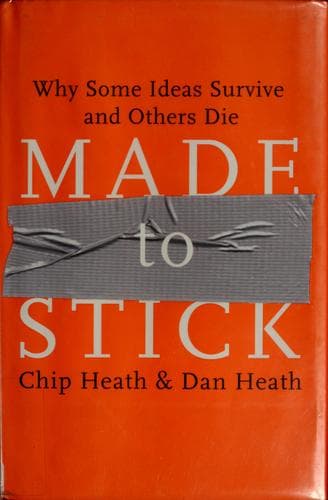
Made to Stick
by Chip Heath and Dan Heath · Published 2007
Ideas become memorable when they are simple, unexpected, concrete, credible, emotional and communicated through stories.
What works
- Excellent for marketing and communication.
- Practical framework.
- Strong examples.
- Useful beyond marketing.
What doesn't
- Framework can become formulaic.
- Not every successful idea needs every characteristic.
- Some examples are stronger than the underlying generalization.
Summary
Chip and Dan Heath begin with a practical question: why do some ideas — from fabricated urban legends to advertising slogans — stay in the mind for years and pass from person to person, while far more important ideas (a safety warning, a critical piece of health advice) get forgotten? They call this staying power "stickiness" and treat it not as an innate talent but as a set of learnable principles.
The book's core is a framework called SUCCESs: sticky ideas tend to be Simple, Unexpected, Concrete, Credible, and Emotional, and are communicated as Stories. For each principle, the Heath brothers provide dozens of real examples — from successful ad campaigns to stubbornly persistent urban legends — to show how these principles work in practice.
The main obstacle the book is written to overcome is what they call the "curse of knowledge": once someone knows something deeply, it becomes almost impossible for them to imagine that others don't know it — and that's exactly what makes their messages complicated and abstract, the opposite of what makes an idea stick.
Key ideas
1. The curse of knowledge: the main barrier to effective communication
The Heaths explain this concept with a simple experiment: in the "tapping game," one person taps out a well-known song's rhythm on a table with their finger, and the other has to guess the song. The tapper hears the full song complete in their head; the listener hears only meaningless taps. In real experiments, tappers expected about 50% of songs to be guessed correctly; the actual figure was close to 2.5%. This enormous gap between what we know and what others can grasp from our message is exactly what makes organisational and educational messaging incomprehensible.
2. The kidney heist: why false legends are so sticky
The authors analyse the famous "kidney heist" urban legend — a story where a traveller meets a stranger in a bar, passes out, and wakes up in a bathtub full of ice to discover their kidney has been stolen. This story is entirely fabricated, but has spread around the world for decades with no marketing campaign, precisely because it naturally carries all six SUCCESs traits: Simple (a one-line plot), Unexpected (the sudden discovery), Concrete (the ice bath), Credible (seemingly precise medical detail), Emotional (fear), and told as a Story. The Heaths treat this as a cautionary example: stickiness is neutral and can transmit a lie just as effectively as it transmits truth.
An idea that is "everything" is, in effect, "nothing."
3. Kennedy's concrete goal: "sending a man to the moon"
The authors treat John F. Kennedy's famous 1961 directive as an example of the power of concreteness. Instead of an abstract goal like "American space superiority," Kennedy said: "landing a man on the moon and returning him safely to earth" by the end of the decade. This line was so concrete that every NASA engineer, with no need for further interpretation, knew exactly what success looked like. The Heaths contrast this with today's vague organisational goals — like "delivering the best customer experience" — which no one can translate into a specific required behaviour.
4. Jared the Subway Guy: story over statistics
Subway's Jared Fogle advertising campaign is one of the strongest examples of the "Story" principle. Instead of an abstract claim like "our sandwiches are healthier," the campaign told the real story of a college student who lost over 200 pounds by eating Subway daily. That single, specific story was far more effective than any nutrition statistic, because it let the brain "simulate" the outcome rather than simply accept it as a number.
5. The unexpected element: breaking the mind's prediction pattern
The Heaths explain that the human mind is constantly predicting what comes next; when reality matches that prediction, attention drops. A sticky idea must deliberately break that prediction pattern — not with irrelevant surprise, but with a gap directly connected to the message's core. They treat this as a practical version of the "curiosity gap" theory: when the mind notices a gap between what it knows and what it needs to know, it naturally wants to close that gap.
Who it's for
- Anyone writing marketing or brand messaging — the SUCCESs framework translates directly into messaging decisions.
- A teacher or educator — the curse-of-knowledge discussion is exactly the barrier that makes effective teaching hard.
- Anyone who has to simplify a technical or complex idea for a non-expert audience — the book's examples target exactly this challenge.
- Anyone looking for a creative tool rather than a framework — this book gives analytical principles, not artistic inspiration.
FAQ
Is the SUCCESs principle only for marketing?
No, the authors deliberately include examples from education, public health and organisational leadership too, to show these principles apply anywhere you need to transmit an idea to others — not only where the goal is a sale.
Why are false legends usually stickier than important truths?
Because legends usually naturally carry all six traits without any deliberate design, while real, important messages are often written by experts caught in the curse of knowledge, who unintentionally make them complicated and abstract.
How do I know if my message is concrete enough?
The Heaths suggest asking whether someone can "picture" or touch your message in their mind. "Best customer experience" isn't picturable; "sending a man to the moon" is.
Is using this book's principles manipulative?
The tool is neutral; whether its use is ethical depends on the honesty of the content you're communicating. The same principles that make an important health message stick can be used to spread misinformation too — the responsibility for choosing honest content rests with the writer.
Where should I start if I want to apply just one principle?
Concreteness, because it has the most immediate impact and is the simplest to apply — replace abstraction with a specific image, number, or example.
Was this useful?
Counts appear once there are 5 votes.