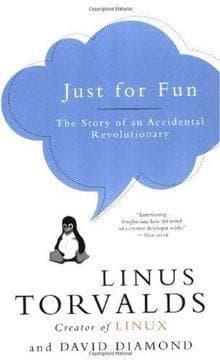
Just for Fun
by Linus Torvalds & David Diamond · Published 2001
Less a technical book than the story of how Linux came about, and of how Torvalds thinks about programming and work. Its appeal is exactly that informal, human account.
What works
- Entertaining.
- Gives insight into Torvalds' personality and philosophy.
- Interesting history of Linux.
- Good counterpoint to conventional startup narratives.
What doesn't
- Not technically deep.
- Some sections are dated.
- More memoir than technology book.
- Less useful if you're looking for engineering knowledge.
Summary
Just for Fun shouldn't be read as a technical book about Linux; it's Linus Torvalds's personal account — written with journalist David Diamond — of how a Finnish student accidentally started one of the most influential software projects in history. The book's tone is informal, casual, and often funny, the exact opposite of the usual tech success story told through grand strategy and careful planning.
Torvalds begins his story with an entirely simple decision: buying a 386 computer in 1991 and pure curiosity about how the hardware worked. The Linux kernel was born not from a business plan but from that same personal curiosity and the enjoyment of solving an interesting technical problem — which is exactly what the book's title is getting at.
A significant portion of the book is devoted to Torvalds's own theory of human motivation: he believes every living thing, from simple organisms to humans, passes through three motivational stages over a lifetime — survival, social order, and finally entertainment. In his view, Linux and the free-software movement are an example of humanity entering that third stage: work no longer done for survival or social status, but simply because it's interesting and enjoyable.
Key ideas
1. The famous Usenet post: "just a hobby"
In August 1991, Torvalds posted a message to the comp.os.minix Usenet group that opened with a now-famous line: he was writing a (free) operating system — just a hobby, won't be big and professional like gnu. That message, one of the most cited documents in software history today, captures exactly the modest, exploratory tone the book itself narrates — a project that no one, not even its creator, imagined would grow this large.
2. The three-stage theory of motivation: survival, social order, entertainment
One of the book's well-known sections is a chapter where Torvalds, half-seriously, proposes a theory about the meaning of life: every living thing first strives for survival, then for standing within social order, and finally — once both are secured — for pure entertainment. He sees Linux as an example of that same third stage: programmers who, in their free time, without direct financial or social incentive, contribute simply for the enjoyment of solving an interesting problem.
3. The decision to release under the GPL
In the book, Torvalds explains why he chose to release Linux under the GNU General Public License (GPL) — a decision that meant giving up exclusive control, but in exchange let anyone see the code, modify it, and contribute, as long as they shared their changes back under the same terms. That choice, not at all obvious at the time, laid the groundwork for thousands of programmers worldwide to work on the Linux kernel without legal obstruction — and that widespread contribution was the main driver of the project's astonishing growth.
4. The story behind Linux's name
One of the book's entertaining anecdotes concerns the project's own name: Torvalds originally wanted to call his project "Freax" (a blend of "free" and "freak"), but when he uploaded the files to the university's FTP server for release, administrator Ari Lemmke, without checking with him first, named the folder "Linux" — and the name stuck. Torvalds says he was self-conscious about it at the time, since it felt egotistical, but he never formally changed it.
5. Succeeding despite, not because of, the absence of a grand plan
One of the book's central arguments is that the absence of a big business strategy at the outset wasn't a weakness for Linux — it was part of why it succeeded. Because there was no investor or heavy business plan involved, Torvalds was free to steer the project purely based on what was technically interesting, and the community of volunteer programmers joined for the same reason — enjoyment of the work, not orders from above.
Who it's for
- Anyone interested in the history of free and open-source software — this book is a first-hand account from one of the most important figures in that history.
- Anyone looking for a real, different example than the usual startup-success narrative — Linux grew without initial investment or a business plan.
- A programmer who wants to understand Torvalds's personality and mindset in his own words — the book's tone is intimate and direct.
- Anyone looking for technical programming instruction or Linux kernel architecture — this is a memoir, not a technical reference.
FAQ
Is this book good for learning programming or Linux?
No, it offers no technical instruction at all. If you're looking to learn Linux or kernel programming, you'll need specialized technical resources; this book is the human and historical story of the project.
Why isn't Linux known as "Freax"?
Because the university FTP server's administrator, without checking with Torvalds first, named the upload folder "Linux," and that name became common. Torvalds, though self-conscious about it at first, never formally changed it.
What exactly is the "survival, social order, entertainment" theory?
It's a half-serious theory Torvalds proposes in the book: every living thing's motivation is first survival, then social standing, and finally entertainment. He sees Linux as an example of human activity in that third stage.
Why did Torvalds release Linux under the GPL?
He wanted anyone to be able to see the code, modify it, and contribute, as long as they shared their changes back freely too. That decision laid the groundwork for widespread global contribution to Linux's development.
Is the book dated?
Parts of it, especially its description of the early-2000s tech industry, feel dated from today's vantage point. But the book's core — the story of Linux's origins and Torvalds's mindset — remains a good, relevant read.
Was this useful?
Counts appear once there are 5 votes.