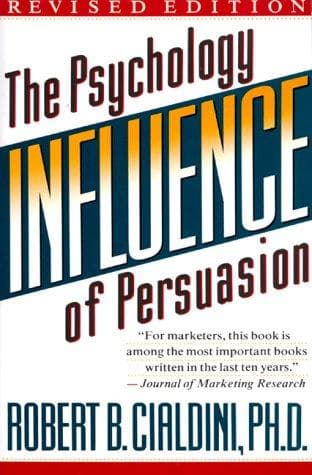
Influence
by Robert Cialdini · Published 1984
People frequently rely on predictable psychological shortcuts when making decisions, creating recurring patterns in persuasion and consumer behavior.
What works
- Foundational behavioral marketing book.
- Highly practical.
- Useful for sales, negotiation and marketing.
- Strong connection between psychology and business.
What doesn't
- Can be applied manipulatively.
- Popularity has produced many oversimplified interpretations.
- Context and culture can affect how persuasion principles work.
Summary
Influence starts from a simple observation: we make thousands of decisions every day, and the brain cannot fully analyse all of them, so it relies on mental shortcuts — rules of thumb that usually work but can be exploited. Robert Cialdini, after years of field research (including working undercover as a salesman, a fundraiser and a marketer), identifies six psychological principles that build these shortcuts and are systematically used by persuasion professionals.
The book's central claim is that these principles — reciprocity, commitment and consistency, social proof, liking, authority and scarcity — are not shallow sales tricks but deeply rooted behavioural patterns that have, over an evolutionary timescale, helped us make fast and usually correct decisions. The problem starts when someone deliberately triggers these shortcuts to push you toward a decision you wouldn't normally make.
Cialdini demonstrates each principle with real psychological experiments and concrete examples from sales, advertising and even cults, turning the book from an abstract list into a practical guide for both defending against persuasion and using it ethically.
Key ideas
1. Reciprocity: the psychological debt of a small gift
When someone gives you something — even something small and unwanted — you feel a debt to repay it, and that feeling is often disproportionate to the gift's actual value. Cialdini cites the well-known example of Hare Krishna members at airports: they would give a small flower to passersby, even when it was refused and dropped to the ground, and this cheap, unwanted gift dramatically raised the rate of subsequent donations. The defence is to accept a gift as a gift, not as an implicit transaction that must be repaid.
2. Commitment and consistency: how one small yes builds bigger ones
People feel a powerful internal pressure to stay aligned with their prior commitments — even small, seemingly trivial ones. Cialdini describes the "foot in the door" technique: obtaining a small initial commitment (like signing a petition) sharply raises the acceptance rate of a much larger request later, because the person now sees themselves as "someone who takes this position" and wants to stay consistent with that self-image.
3. Social proof: when "everyone is doing it"
In uncertain situations, we take other people's behaviour as a guide for our own. Cialdini explains this with the bystander effect — when a large crowd witnesses an incident but no one helps, because each person sees the others not reacting and treats that inaction as evidence the situation must be normal. The same principle shows up in advertising as "best-selling product" claims or customer reviews.
We decide what is correct behaviour in a situation by observing what others are doing.
4. Authority: obeying the signals, not necessarily real expertise
Clothing, titles and symbols of authority — like a doctor's white coat — can produce obedience on their own, even when the person has no real qualification. Cialdini references the classic psychological studies on obedience to authority, which show people are willing to follow instructions they would never accept under ordinary circumstances, simply because the instruction came from an apparently legitimate source. The defence is asking one question: is this person actually an expert, or do they just carry the signals of expertise?
5. Scarcity: valuing access, not quality
When something appears limited or running out, it becomes more desirable — even if nothing about its quality has changed. Cialdini cites the well-known cookie-jar experiment: when the number of cookies in a jar was reduced from ten to two, with no change to taste or quality, people's rating of how delicious the same cookies were went up. Phrases like "only a few left" or "limited-time offer" trigger exactly this psychological lever.
Who it's for
- Anyone working in sales, negotiation or marketing — the six principles translate directly into everyday messaging and pricing decisions.
- Anyone who wants more resistance to unwanted persuasion — recognising these principles is the first step in defending against them.
- Anyone designing products or interfaces — social proof and scarcity are now a standard part of e-commerce interface design.
- Anyone interested in social psychology — a foundational book that much later research in the field references.
FAQ
Does knowing these principles actually make you immune to them?
Not fully. Cialdini himself admits that even with complete knowledge of these principles, he still sometimes falls under their influence, because these reactions are automatic and unconscious. What actually helps is stopping and asking a simple question at the moment of decision: am I making this decision for the real reason, or because one of these levers has been triggered?
Which principle is the strongest?
Cialdini gives no explicit ranking, but commitment and consistency may be the deepest in terms of durability — because unlike scarcity, which is temporary, commitment ties into a person's self-image and can shape decisions for years.
Is using these principles in marketing unethical?
Cialdini himself distinguishes honest use (showing genuine scarcity, real authority) from manufactured use (fake scarcity, fabricated authority). The principles are neutral in themselves; whether their use is ethical depends on the honesty of the application.
Why is it still cited decades later?
Because its central findings have been replicated many times in later research and its framework is simple and memorable. Few books in applied psychology have pushed their vocabulary ("social proof," "scarcity") this deeply into everyday language.
Where should I start if I only want to learn one principle deeply?
Commitment and consistency. Its effect is slower but more durable than the others, and understanding it helps explain why you sometimes stay committed to decisions that no longer serve you.
Was this useful?
Counts appear once there are 5 votes.