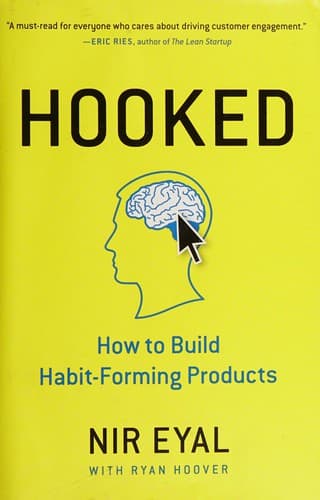
Hooked
by Nir Eyal · Published 2014
Products can become habitual when repeated cycles of triggers, actions, rewards and user investment reinforce behavior.
What works
- Useful product psychology framework.
- Easy to understand.
- Relevant to product and growth.
- Good explanation of habit-forming products.
What doesn't
- Can encourage manipulative design.
- Human behavior is more complex than the model suggests.
- Ethical considerations deserve more attention.
As an affiliate, I may earn a small commission if you buy through this link — at no extra cost to you.
Summary
Hooked poses a practical question for product designers: why do some products — social networks, mobile games, email apps — automatically become part of our daily routine, without any conscious decision to use them repeatedly? Nir Eyal, combining behavioural psychology with his own experience in product design, finds the answer in a repeatable four-stage pattern he calls the "Hook Model."
The book's central claim is that habit-forming products shape user behaviour not through one specific feature but through a repeating psychological cycle: trigger, action, variable reward, and investment. Each time this cycle completes, the likelihood of repeating it in the future rises — until the behaviour no longer needs an external reminder and calls itself up from within.
Eyal writes the book as a design guide, but deliberately devotes its final section to the ethical question: when is habit-forming design a genuine service to the user, and when does it become manipulation?
Key ideas
1. Trigger: external versus internal
Every habit begins with a trigger. External triggers (a notification, an email, an ad) push the user toward an action from the outside and are necessary to start usage. But the real goal of a habit-forming product is the gradual transition from external to internal trigger — a feeling like boredom, loneliness or uncertainty that, on its own, with no notification at all, pulls the user toward the product. Once a product becomes linked to a common negative emotion, it no longer needs an external reminder.
2. Action: the simplest possible behaviour
Eyal borrows from BJ Fogg's behaviour model: a behaviour occurs when sufficient motivation, sufficient ability, and a trigger are present simultaneously. He stresses that designers often focus on increasing motivation, when reducing the difficulty of the task — fewer clicks, lower cognitive load — is usually the more powerful lever. The action should be as simple as possible, because the easier it is to perform, the more likely it is to be repeated.
Products that shape our daily behaviour often solve pains we aren't fully aware we have.
3. Variable reward: the lesson of slot machines
Eyal points to B.F. Skinner's classic research on variable-ratio reinforcement: pigeons that received rewards at irregular intervals repeated their behaviour far more, and more resistantly, than pigeons that received rewards on a fixed schedule — exactly the mechanism that makes slot machines so addictive. He identifies three types of variable reward in digital products: rewards of the tribe (social validation, like a like), rewards of the hunt (resources or information, like an endless feed scroll), and rewards of the self (mastery or completion, like reaching the next level of a game). It's the uncertainty of the reward, not the reward itself, that makes behaviour sticky.
4. Investment: the user puts in something that loads the next trigger
The model's final stage is where the user — not the company — invests something into the product: data, content, followers, reputation, or even time and effort. This investment does two things: it increases the product's value for that same user (a personalised feed, a completed profile), and it preloads the next round's trigger (a new like on something you posted brings you back to check it). Eyal treats this as the main difference between the hook cycle and a simple advertisement: each round makes the next round more likely.
5. The ethical test: facilitator or peddler?
In the final section, Eyal proposes a framework for product builders themselves: do you use this product yourself? Does it genuinely improve the user's life? He distinguishes between a "facilitator" — someone building a product they themselves consume and honestly believe helps the user — and a "peddler" — someone who knows the product is harmful to the user but designs it anyway because it's profitable. This simple test gives designers a quick self-assessment tool, though its honest application depends entirely on the designer's own conscience.
Who it's for
- A product designer or product manager who wants to understand user engagement — the framework was written for exactly this.
- Anyone who wants to understand why they've become hooked on certain apps themselves — the book clarifies the mechanism behind this everyday experience.
- Anyone working in tech ethics or responsible design — the final section is a good starting point for discussion, even if it doesn't give a complete answer.
- Anyone looking for a comprehensive product-growth guide — this book focuses on only one part of the product cycle (habit formation), not the whole growth strategy.
FAQ
Is using this model inherently unethical?
Eyal himself says no — the model is neutral, like any other psychological tool. The ethical difference is whether the product genuinely adds value to the user's life or simply extracts their time and attention with no real return.
Why does "variable" reward matter so much more than a fixed reward?
Because uncertainty activates curiosity and the urge to check again. If you knew a social feed always showed exactly the same thing, the motivation to check it repeatedly would vanish; it's that uncertainty that turns checking into a habit.
Does this model only apply to mobile apps?
No, its underlying principles are far older than mobile — traditional marketing, store design and even social relationships use similar mechanisms. Mobile has simply made this cycle faster and more frequent.
How does it differ from older motivation theories?
Rather than focusing purely on intrinsic or extrinsic motivation, Eyal builds a complete behavioural cycle that ties these factors to actual product design — something classic motivation theories alone don't provide.
Can this framework be used for beneficial habits too?
Yes, and Eyal himself raises this as one of the model's positive applications — fitness or language-learning apps, for instance, that use the same cycle to reinforce constructive habits. The mechanism is neutral; the outcome depends on the designer's intent.
Was this useful?
Counts appear once there are 5 votes.