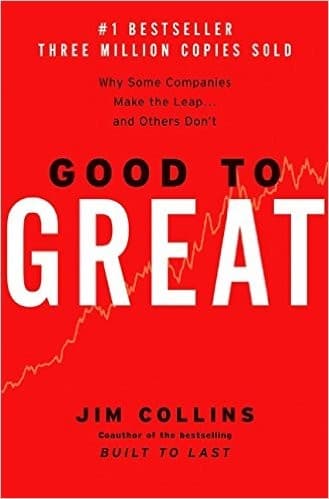
Good to Great
by Jim Collins · Published 2001
Long-term organizational excellence tends to come from disciplined people, disciplined thinking and disciplined execution rather than spectacular short-term decisions.
What works
- Memorable management frameworks.
- Strong discussion of leadership.
- Useful strategic concepts.
- Influential business research.
What doesn't
- Survivorship bias is a concern.
- Some findings have faced methodological criticism.
- Certain conclusions are too easily generalized.
As an affiliate, I may earn a small commission if you buy through this link — at no extra cost to you.
Summary
Jim Collins and his research team asked a seemingly simple question: why do some companies leap from average to sustained excellence, while most comparable companies never make that leap? They screened 1,435 companies down to eleven whose stock returns beat the market and their competitors by a wide, sustained margin for fifteen years, then compared each to a "comparison company" in the same industry that never made that leap.
The book's central finding runs against common expectation: the great transformation is usually not the result of a revolutionary strategy or a charismatic leader. It's the result of accumulated disciplined decisions, the right people, and consistent execution over years — a process that looks like a sudden leap from the outside but is gradual and quiet from within.
Collins introduces several concepts to explain this pattern, each of which has become part of standard management vocabulary on its own: Level 5 Leadership, the Hedgehog Concept, the flywheel versus the doom loop, and confronting the brutal facts.
Key ideas
1. Level 5 Leadership
Leaders of the "great" companies had an unexpected combination: deep personal humility alongside indomitable professional will. They credited the team or luck for success but personally took responsibility for failure — the exact opposite of the popular image of a charismatic, spotlight-seeking CEO. Collins calls this "Level 5," the top of a five-level hierarchy he maps for organisational leadership.
2. First who, then what
Against the common pattern of "set the vision first, then find the right people to execute it," the great companies inverted the order: they got the right people "on the bus" and the wrong people off it first, and only then decided the exact direction. Collins's logic is that the right people will find the right path on their own in almost any circumstance; but even the best strategy fails with the wrong people.
When in doubt about which direction is right, the best thing you can do is get the right people around you who can figure it out with you.
3. The Hedgehog Concept
Collins borrows Isaiah Berlin's fox-and-hedgehog metaphor: the fox knows many things, the hedgehog knows one big thing. The great companies had hedgehog-like focus instead of fox-like scattering — each found a single "Hedgehog Concept": the intersection of three circles — what you can genuinely be best in the world at, what you are deeply passionate about, and what drives your economic engine. Major decisions were made only when they fell within all three circles.
4. The flywheel versus the doom loop
The great companies experienced transformation not as a single announced revolutionary moment but like turning a heavy flywheel: each small push looks insignificant on its own, but with consistent repetition, momentum accumulates until the wheel begins accelerating on its own. In contrast, the comparison companies often got stuck in a "doom loop" — grand, announced programs that never got the chance to build momentum, because they were replaced by the next grand program before taking hold.
5. The Stockdale Paradox: confronting the brutal facts
Collins drew this concept from a conversation with Admiral Jim Stockdale, an American prisoner of war held in Vietnam for eight years. Stockdale told Collins that the most optimistic prisoners — those who confidently believed "we'll be out by Christmas," and then grew crushed Christmas after Christmas — often broke down sooner than others. Those who endured held a paradoxical combination: unwavering faith in eventual victory, together with total acceptance of the brutal facts of the present moment. The great companies showed this same combination — frank acknowledgment of problems, without losing faith in the long-term direction.
Who it's for
- A manager or leader pursuing long-term transformation — not a quick fix, but a framework for durable change.
- Anyone building a team — the "first who" argument translates directly into hiring and firing decisions.
- Anyone writing business strategy — the Hedgehog Concept is a good tool for narrowing focus.
- Anyone looking for flawless statistical findings — the book's methodology, while serious, has faced criticism worth weighing.
FAQ
Are the companies featured in the book still successful?
Not all of them. Some, like Fannie Mae, faced serious financial crises, and others declined with market shifts. This shows the book's principles are useful for achieving excellence but no guarantee of keeping it forever — markets change.
How is the Hedgehog Concept actually found in practice?
Collins says finding it takes time — the successful companies typically took four years or more to discover it, through deep, honest discussion of all three circles, not a one-day brainstorming session.
Why is Level 5 Leadership so rare?
Because it conflicts with the popular cultural image of successful leadership. Business culture often celebrates charismatic, spotlight-seeking leaders, while Collins argues that exact trait can block long-term excellence, because it makes the organisation dependent on a person rather than a system.
What's the practical use of the Stockdale Paradox?
In organisational decision-making, it means speaking honestly about current problems — neither concealing them nor falling into total despair — while maintaining commitment to the long-term goal. Teams that show only optimism often don't see real problems until it's too late.
Does this book apply to small companies too?
The underlying principles — focus, the right people, consistent momentum — yes. But the book's specific examples come from large companies with extensive resources; a small team has to redefine the same principles at a much smaller scale.
Was this useful?
Counts appear once there are 5 votes.