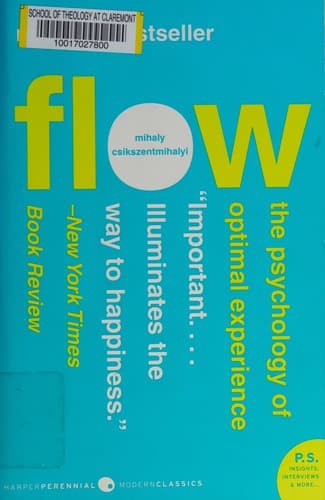
Flow
by Mihaly Csikszentmihalyi · Published 1990
People perform and experience life differently when they become deeply absorbed in challenging activities that match their abilities.
What works
- Foundational concept in positive psychology.
- Highly relevant to work and creativity.
- Strong explanation of intrinsic motivation.
- Applicable far beyond psychology.
What doesn't
- Some concepts are difficult to measure.
- Flow isn't automatically the same as productivity.
- Modern productivity culture sometimes oversimplifies it.
As an affiliate, I may earn a small commission if you buy through this link — at no extra cost to you.
Summary
Mihaly Csikszentmihalyi, the Hungarian-American psychologist, began this book's research with a simple question: why do some people — painters, climbers, chess players, surgeons — become so deeply absorbed in their work that they forget hunger, fatigue and even time? He named this state flow, and over years of interviews and field research across different cultures, uncovered the common mechanism behind it.
The book's central claim is that quality of life comes not from external events but from the quality of conscious experience we construct moment by moment — and controlling that experience is a skill that can be learned. Flow is the state in which that control reaches its peak: goals and feedback are so clear, and challenge is so precisely matched to ability, that ordinary self-consciousness dissolves and the person and the activity become one.
Csikszentmihalyi emphasises that flow isn't limited to "great" or creative activities — it can occur in programming, cooking, conversation or even manual labour. What creates it is the structure of the activity, not its content.
Key ideas
1. The challenge-skill balance
Flow occurs exactly at the point where an activity's challenge matches a person's skill level. If the challenge is too high, anxiety results; if too low, boredom. Csikszentmihalyi represents this as a diagram: a narrow channel between these two regions, where flow becomes possible. The practical consequence is that enjoyable activities must become harder over time — the same simple game that once produced flow becomes boring once your skill has grown past it.
2. Clear goals and immediate feedback
Activities that produce flow almost always share two traits: a goal that is clear at every moment (not a vague, distant end goal) and feedback that arrives instantly. A musician knows immediately whether they hit the right note; a climber knows immediately whether their grip on the rock is secure. This moment-to-moment clarity is what stops the mind from wandering and keeps it entirely focused on the present.
The best moments usually occur when a person's body or mind is stretched to its limits in a voluntary effort to accomplish something difficult and worthwhile.
3. Autotelic experience: acting for the sake of the act itself
Csikszentmihalyi uses the term autotelic for activities pursued for their own reward, not for some later external outcome. Someone with an "autotelic personality" has the ability to find flow in almost any circumstance — not because the circumstance is easy, but because they've learned to organise their attention so that nearly any activity can become meaningful. This runs against the common assumption that flow is a product of ideal external conditions; it is, in fact, more a product of internal attentional order.
4. Csikszentmihalyi's original finding: artists who forgot they were hungry
Before he coined the term "flow," Csikszentmihalyi studied painters and sculptors who worked for hours without pause, ignoring hunger and fatigue, and who, once the work was complete, showed little interest in its fate. This early observation convinced him that the real reward wasn't in the finished piece or others' praise, but in the process of creation itself — an insight that shaped his entire theory.
5. Flow versus productivity
One important distinction Csikszentmihalyi draws is that flow is not automatically the same as higher productivity. A person can spend hours in a flow state doing something unproductive — a well-designed video game, for instance. What makes flow valuable is the quality of conscious experience, not necessarily the outcome's external worth. This distinction is an important warning against a purely instrumental reading of the book that treats flow only as a productivity trick.
Who it's for
- Anyone seeking deeper motivation than external reward in their work or creativity — the field's foundational framework.
- A product or game designer — the challenge-skill balance translates directly into user-experience design.
- Anyone who finds their activities either too easy or too hard — the book's framework gives a tool for diagnosing and adjusting that imbalance.
- Anyone looking for a step-by-step recipe for reaching flow — the book gives a framework, not a precise formula; applying it requires personal adaptation.
FAQ
Can you deliberately "activate" flow?
Not directly, but you can construct the conditions for it: choose an activity with a clear goal, immediate feedback, and a challenge precisely matched to your current skill. Flow is the result of these conditions, not something summoned by direct willpower.
Why does the same activity produce flow one day and not another?
Usually because the challenge-skill balance has shifted — you're tired, your skill has grown and the activity now feels too simple, or you're distracted and can't build the required focus. Flow depends on conditions, not a fixed property of the activity.
Is flow always good?
Not necessarily. You can become absorbed in a destructive or worthless activity too — gambling, an addictive video game. Csikszentmihalyi explicitly warns that the flow experience itself is neutral; its value depends on which activity it occurs within.
How does it differ from intrinsic motivation?
Flow is the state of experience; intrinsic motivation is the explanation for why you do something. The two are related but not identical — you can have strong intrinsic motivation without reaching flow, if the structural conditions (clear goal, immediate feedback) aren't in place.
Does this hold true across all cultures?
Csikszentmihalyi conducted his research across multiple cultures — from factory workers in Italy to American climbers — and found a similar pattern. This suggests the flow mechanism is largely universal, though the activities that produce it vary from culture to culture.
Was this useful?
Counts appear once there are 5 votes.