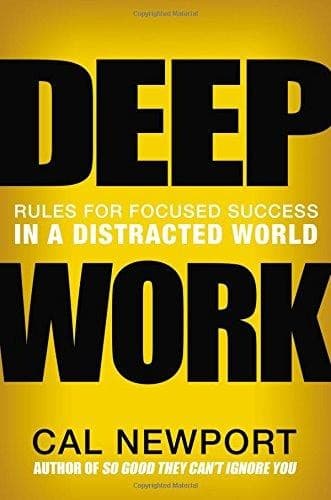
Deep Work
by Cal Newport · Published 2016
One of the most practical books on this list. What I value most is that it treats focus not as a personality trait but as a competitive advantage.
What works
- Extremely practical.
- Directly applicable to knowledge work.
- Strong framework for managing distractions.
- Makes a convincing economic argument for concentration.
What doesn't
- Some recommendations assume significant control over your schedule.
- Less applicable to highly collaborative jobs.
- Can become overly rigid if treated as a universal productivity system.
Summary
Newport's central claim is this: the ability to focus deeply and without interruption on a demanding cognitive task is becoming one of the rarest and yet most valuable skills in today's economy — at the exact moment digital tools make it harder than ever. He defines "deep work" against "shallow work": logistical and administrative tasks, often performed while distracted, that create little cognitive value and are easily replicated.
The book's economic argument is this: in an economy where AI and automation are consuming repetitive tasks, two skills remain genuinely valuable — the ability to quickly learn complex material, and the ability to produce at an elite level in both quality and speed. Both depend directly on your capacity for deep work.
The book's second half is practical: four rules for building that capacity, from setting fixed work rituals to deliberately managing social media and email. Newport is himself a computer science professor, and writes not as a guru but as someone who applies these exact principles to publishing academic papers.
Key ideas
1. Deep work versus shallow work
Newport draws a sharp distinction: deep work is professional cognitive activity performed in a state of distraction-free concentration, that pushes your abilities to their limit, and creates value that is hard to replicate. Shallow work — checking email, brief meetings, administrative tasks — is usually possible even while distracted, and for exactly that reason can easily be automated or delegated. The problem isn't that shallow work is worthless; it's that in most organisations its volume has grown so large it leaves no room for deep work.
2. Attention residue
When you move from task A to task B, part of your attention remains stuck on A — a phenomenon Newport calls attention residue. The more unfinished task A was, the stronger this residue is. The practical consequence is that a quick "just one minute" email check between other tasks has a hidden cost far larger than that one minute — part of your cognitive capacity stays engaged with it for some time afterward.
The ability to perform deep work is becoming increasingly rare at exactly the same time it is becoming increasingly valuable in our economy.
3. Rituals and deliberate withdrawal: Jung's tower and Rowling's hotel
Newport draws on several historical examples to show that deep work requires structure, not just motivation. Carl Jung built a stone tower at Bollingen with no electricity or telephone, specifically for deliberate intellectual isolation. J.K. Rowling checked into a hotel with no internet access to finish the final Harry Potter book. Both examples point to the same pattern: real depth rarely happens by accident; it requires an environment that makes distraction fundamentally impossible, not one that merely "manages" it.
4. The four rules for building deep-work capacity
Newport turns these ideas into four practical rules: work deeply (protect specific, dedicated blocks of time), embrace boredom (practise tolerating brief idleness without reaching for your phone), quit social media (choose tools based on real benefit, not habit), and drain the shallows (schedule shallow work into a fixed window so it doesn't leak into the rest of the day).
5. Becoming hard to reach as a strategy
One of the book's counterintuitive recommendations: instant availability to everyone has a cost that usually goes unnoticed. Newport suggests setting explicit filters instead of quickly answering every email — for instance, only responding to requests that meet criteria you've defined in advance. This "deliberate hard-to-reach-ness" isn't rudeness; it's protection for the time in which genuinely valuable work happens.
Who it's for
- A knowledge worker who feels busy all day but sees little real progress — exactly the experience the book was written for.
- Anyone working on a long-term intellectual project — a writer, researcher, developer, designer.
- Anyone with significant control over their daily schedule — the book's rules are more actionable for someone with real work autonomy.
- Anyone whose job is deeply moment-to-moment collaborative — this book fits less well; its baseline assumption is uninterrupted blocks of time.
FAQ
Is this a book about time management?
Not exactly. Time management is about scheduling; this book is about the quality of attention within that time. You can have a perfectly organised schedule and still never do deep work if your attention keeps fragmenting.
Does it apply to someone with a collaborative, meeting-heavy job?
Less directly, but the underlying principle — protecting uninterrupted blocks of time — is adaptable. Even a few short protected blocks per week can make a difference, though the book's full system wasn't written for these roles.
Why does the book target social media so much?
Newport doesn't consider it inherently bad; he argues it's often used without any real cost-benefit analysis. His recommendation isn't "delete everything," but an explicit test: does this tool genuinely serve my important goals, or has it just become a habit?
How real is the Jung tower example?
Fully documented. Carl Jung built the Bollingen tower in the 1920s and spent much of his life there, away from phone and electricity, thinking and writing. Newport treats it as an example of how great intellectual work often requires deliberate physical distance from distraction.
Where should I start if I only want to make one change?
One protected block of time per day — even ninety minutes — where your phone is in another room and notifications are off. Newport believes that one change alone shifts the quality of work more than any app or tool.
Was this useful?
Counts appear once there are 5 votes.