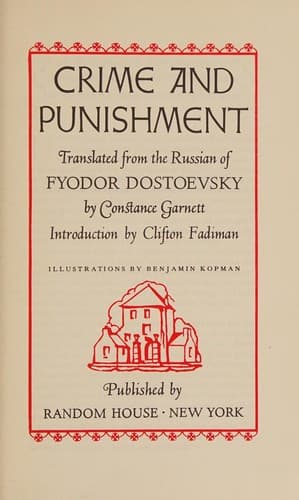
Crime and Punishment
by Fyodor Dostoevsky · Published 1866
The deepest consequences of wrongdoing may not come from external punishment but from the conflict between one's actions, conscience and beliefs.
What works
- Extraordinary psychological depth.
- Complex moral questions.
- Exceptional character development.
- Philosophically rich.
What doesn't
- Long and demanding.
- Philosophical sections can slow the narrative.
- Russian naming conventions can initially be confusing.
Summary
Crime and Punishment opens with a murder, not at the end — Raskolnikov, a former, impoverished law student in St. Petersburg, kills an elderly pawnbroker with an axe, ostensibly to steal her money, but really to test a theory: is he one of the "extraordinary" people permitted to step outside ordinary morality? From that moment, the story continues not about who the murderer is, but about what happens inside the murderer's mind afterward.
Rather than a police mystery, Dostoevsky builds a psychological novel: Raskolnikov suffers not from fear of arrest but from his own internal disintegration. He runs a fever, rambles deliriously, withdraws from others, and every relationship — with his mother, his sister, his friend Razumikhin — becomes a painful reminder of the distance he has put between himself and his own humanity.
Alongside this collapse, two forces pull him in opposite directions: Porfiry Petrovich, the investigator who, without any direct evidence, closes in on the truth purely through psychological pressure; and Sonya, a young woman who has turned to prostitution to support her family, whose faith and self-sacrifice stand as the exact opposite of Raskolnikov's cold, abstract theory.
Key ideas
1. The "extraordinary man" theory
Before the murder, Raskolnikov had written an essay arguing that history is driven forward by extraordinary individuals — like Napoleon — who have the right to step outside ordinary moral law if their purpose serves humanity. He tests himself: is he really one of these "supermen," or just an ordinary, frightened man looking for a justification for his crime? The whole novel, in one sense, is the bitter answer to that question — and the answer refutes his theory not through philosophical argument, but through the actual collapse of his own psyche.
2. Internal punishment versus external punishment
The title is misleading if you expect "punishment" to mean arrest and prison. Raskolnikov's real punishment begins months before any formal interrogation, inside his own mind: alienation from family, an inability to connect emotionally, and a constant conflict between what he's done and what he still believes he ought to be. Dostoevsky shows that conscience, even when consciously denied, erodes the body and mind from within.
Pain and suffering are always inevitable for a large intelligence and a deep heart.
3. Sonya: faith and sacrifice against theory
Sonya Marmeladova turned to prostitution to save her family from starvation — a choice that makes her a social outcast, but Dostoevsky makes her the novel's purest character. Her contrast with Raskolnikov is fundamental: Raskolnikov went toward crime through theory; Sonya accepted suffering through tangible sacrifice with no philosophical justification at all. When Raskolnikov finally confesses his crime to her, she responds not with judgment but by asking him to accept his suffering and return to faith — the path Dostoevsky treats as the only genuine road to redemption.
4. Porfiry Petrovich: psychological interrogation instead of evidence
Porfiry, the case's investigator, never has definitive evidence against Raskolnikov; instead he uses indirect conversation, subtle hints, and calculated psychological pressure to draw Raskolnikov to the edge from within. This interrogation method — now a recognisable pattern in crime fiction — shows that Dostoevsky arrived, ahead of formal psychology, at the insight that a guilty mind is often drawn toward confession even without external pressure.
5. Redemption through suffering: the Siberian epilogue
The novel doesn't end with Raskolnikov's confession and exile to Siberia — it begins there. The epilogue, which some readers consider rushed, shows his real transformation — not at the moment of confession, but months later, when Sonya, who has followed him to Siberia, finally manages to break through his intellectual wall. The deeply religious Dostoevsky depicts redemption not through legal punishment, but through the complete acceptance of suffering and a return to faith.
Who it's for
- Anyone who values psychological depth in character — few novels narrate a mind's collapse with this much depth.
- Anyone interested in complex moral questions — the extraordinary-man theory is still alive in philosophical debate.
- Anyone with patience for a long, demanding novel — this book isn't read quickly and shouldn't be rushed.
- Anyone looking for a fast-paced mystery — this novel isn't a mystery; you know the murderer from the first pages.
FAQ
Should I know the crime in advance so it isn't spoiled?
Don't worry; Dostoevsky himself places the murder in the very first chapters of the novel. This book isn't about "who did it" — it's about "what happened to his mind afterward."
Why is Raskolnikov so unsympathetic?
Dostoevsky deliberately makes him not a charming antihero but a contradictory, proud, and often irritating person — precisely because his goal is to show the real disintegration of a mind, not to build a hero the reader roots for.
Which translation should I read?
This depends on the target language, but generally newer translations that stay truer to Dostoevsky's rough, direct prose style are preferred over older, more polished ones.
How does it differ from The Brothers Karamazov?
Crime and Punishment is more focused and shorter — one mind, one crime. The Brothers Karamazov is broader and more philosophical. For a first encounter with Dostoevsky, this book is the better entry point.
Is Raskolnikov's theory still discussed today?
Yes, in various forms — from philosophical debates about consequentialist ethics to cultural critiques of the idea of the "exceptional genius above the law." Dostoevsky raises this idea in order to destroy it from within, not to defend it.
Was this useful?
Counts appear once there are 5 votes.