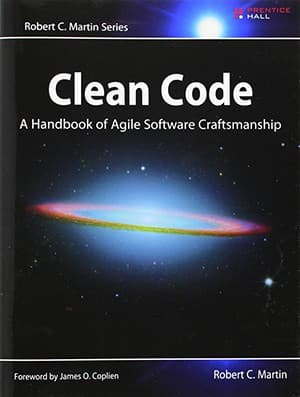
Clean Code
by Robert C. Martin · Published 2008
Code should be written primarily for humans to understand and maintain, not merely for computers to execute.
What works
- Excellent introduction to maintainable code.
- Strong focus on readability.
- Practical examples.
- Influential engineering principles.
What doesn't
- Some recommendations are overly dogmatic.
- Several examples are dated.
- Experienced engineers may disagree with specific rules.
- "Clean" code is contextual.
Summary
Clean Code makes a professional-ethical claim that Robert Martin (known as Uncle Bob) states firmly: bad code is not a stylistic choice but professional irresponsibility. His argument is that code is read, understood and maintained by humans far more than it is "executed" by a computer — the ratio of time spent reading code to writing it heavily favours reading — so the primary quality standard should be readability and comprehensibility, not merely working correctly.
The book combines principles (naming, function length, class structure, comments) with hands-on examples, where Martin rewrites real code snippets step by step to show how seemingly functional code can simultaneously be completely incomprehensible. Much of the book circles a single idea: clean code isn't a final state, it's a continuous act — something done every time code changes, not once at the start of a project.
Martin writes explicitly for programmers who want to move from "coder" to "software craftsman" — someone who accepts responsibility for the long-term quality of the code they write, not just for delivering something that works today.
Key ideas
1. Names should say why they exist
Martin argues that choosing a name for a variable, function or class is the most important and cheapest quality decision a programmer makes every day. A good name should convey why something exists and how to use it, without needing a comment. He rejects vague names like d for elapsed time and suggests names should be expressive enough that code reads like prose, not cipher.
2. Functions should do one thing
Martin's rule is explicit: a function should do one thing, do it well, and do only that thing. He argues most long functions are actually several smaller functions hidden inside one body, waiting to be extracted. His practical test is: if you can extract part of a function and give it a meaningful name, that function is doing more than one thing.
The only way to go fast is to go well.
3. Comments are often a sign of failure, not virtue
Contrary to the common belief that "more comments means better code," Martin argues a comment is often an apology for code that failed to express itself clearly. The best comment is the one you don't need, because the names and structure of the code themselves convey intent. He warns that comments drift away from code over time and become lies — code that changes while its comment doesn't get updated is worse than no comment at all.
4. The Boy Scout Rule: leave code cleaner than you found it
This rule — which Martin borrows from the American Boy Scouts — says every time you touch a piece of code, leave it a little better than before: fix a bad name, shorten a long function, simplify a complex condition. The key point is that this improvement shouldn't be a separate project or a "big rewrite"; it should be a natural part of every small everyday change. The sum of these small improvements, over time, is more effective than any one-off effort to "clean up" the codebase.
5. Test-driven development and its three laws
Martin introduces three laws of test-driven development: you may not write production code until you have written a failing unit test; you may not write more of a unit test than is sufficient to fail; and you may not write more production code than is sufficient to pass the currently failing test. This tiny, repeated cycle — test, code, refactor — ensures the codebase always has full test coverage and removes the fear of touching old code, because every change is immediately checked by the tests.
Who it's for
- A programmer transitioning from "code that works" to "code that's maintainable" — exactly the shift the book targets.
- A team without a shared standard for code review — the book's vocabulary and criteria give a foundation for team discussions.
- Anyone maintaining an old, tangled codebase — the Boy Scout Rule is designed specifically for this situation.
- A very experienced engineer with an established personal style — may disagree with some of the book's more dogmatic rules.
FAQ
Should I follow every rule in the book to the letter?
No. Even Martin doesn't present the rules as the final word, but as a tool for thinking. The best use of the book is understanding the principles and then deciding, based on your project's context, which ones actually apply.
How does it differ from The Pragmatic Programmer?
The Pragmatic Programmer is about being an engineer — habits, ownership, automation. This book is about writing the code itself — naming, function structure, class organisation. If you're reading one, this one is more directly about improving everyday code.
Does the Boy Scout Rule need management approval?
Usually not, because it means small changes within work you're already doing, not a separate project. Martin explicitly warns that "the big rewrite" often never finishes; gradual, continuous improvement is more realistic.
Why do some experienced engineers disagree with this book?
Mostly because of the dogmatism of some rules. Engineers who have worked across many contexts know "short function" or "no comments" isn't always the best choice; sometimes one long linear function is more readable than ten scattered small ones.
Does it still apply to more modern programming languages?
The high-level principles — naming, single responsibility, avoiding unnecessary comments — are language-independent. The book's code examples are written in Java and some patterns look different in functional or more modern languages, but the underlying principle still holds.
Was this useful?
Counts appear once there are 5 votes.