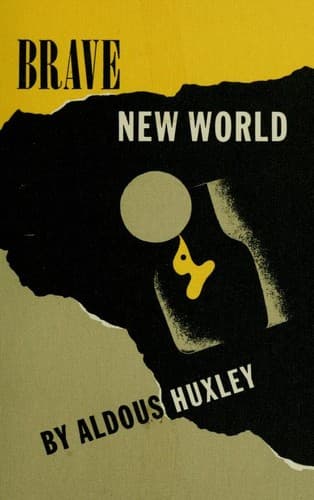
Brave New World
by Aldous Huxley · Published 1932
A society doesn't necessarily need violence to control people; comfort, entertainment, consumption and conditioning can make people willingly accept the system around them.
What works
- Excellent counterpoint to 1984.
- Strong exploration of technology and consumerism.
- Questions whether happiness without freedom is actually desirable.
- Remains highly relevant.
What doesn't
- Some characters feel more symbolic than human.
- Parts of the world-building feel dated.
- Less emotionally powerful for some readers than 1984.
Summary
Brave New World depicts a world state that, unlike Nineteen Eighty-Four, controls not through fear and torture but through comfort, pleasure and consumption. Humans are "manufactured" in laboratory bottles through a process called the Bokanovsky Process, and from the embryonic stage are assigned to one of five social castes — Alpha through Epsilon. Each caste is conditioned through hypnopaedia (sleep-teaching) to love exactly the position it has been assigned.
Huxley asks a question Nineteen Eighty-Four never asks: if people are genuinely content with their servitude, does freedom still matter? The main instrument of that contentment is the drug soma — a substance with no apparent side effects that erases any discomfort within minutes. Alongside soma, constant entertainment ("the feelies"), encouraged consumerism, and completely free, commitment-free sex all work to eliminate any need for repression.
Bernard Marx and then John — a boy raised outside the system, on a "Savage Reservation," on a diet of Shakespeare — give the story two different vantage points on this system. John's collision with the new world, and his eventual suicide, is the book's philosophical core: is happiness without meaning, suffering, or genuine choice actually worth living?
Key ideas
1. The Bokanovsky Process: manufacturing humans instead of birthing them
In Huxley's world, pregnancy and birth have become ugly, shameful words. Humans are produced in a factory: embryos grow in bottles and, through manipulated oxygen and chemicals, are "programmed" from the embryonic stage for the intelligence and physical capability their social caste requires. Epsilon embryos are deliberately kept oxygen-deprived so their intelligence stays limited — because society needs a large number of workers content with repetitive labour.
2. Hypnopaedia: conditioning through repetition
Every child hears, thousands of times in their sleep, phrases that engrave their caste's values into their mind — Epsilons, for instance, hear "I'm glad I'm not an Alpha, because Alphas have to work." The repetition runs so deep that by adulthood these beliefs no longer feel like "conditioning"; they've become part of the person's identity. Huxley treats this as more powerful than any external censorship: control that comes from inside needs no coercion.
Everyone belongs to everyone else.
3. Soma: a drug that makes no one angry
Soma erases any negative emotion — sadness, anger, boredom — within minutes, with no hangover or visible long-term effect. The government distributes it for free, not because it worries about citizens' wellbeing but because a citizen who never truly suffers never truly rebels. Huxley builds his own version of control here: rather than suppressing pain, they eliminate it entirely — and along with it, any motive to change the status quo.
4. Consumerism as the official religion
In this world, "Ford" (after Henry Ford) has replaced God, and society's official slogan is "the more you consume, the better." Citizens are conditioned from childhood to hate old toys and always buy something new — a consumption cycle that turns the economy while simultaneously distracting the mind from bigger questions.
5. John and Shakespeare: the collision of two value systems
John grew up on the Savage Reservation with the complete works of Shakespeare — the only book that made it there — and through it learned concepts like painful love, jealousy, guilt and meaningful death that don't exist at all in the new world. When he enters the "civilised" world, he encounters not just technology but a profound lack of meaning: people who never suffer never love deeply either. His suicide at the end is a final protest against a world that has stripped him even of the right to choose to suffer.
Who it's for
- Anyone who has read Nineteen Eighty-Four — the best possible counterpoint; it sets two entirely different models of social control side by side.
- Anyone thinking about technology, consumerism and today's media — Huxley's predictions about entertainment and distraction feel unsettlingly current.
- Anyone who likes philosophical questions about happiness — the book's central question (is happiness without freedom worth having) still has no clean answer.
- Anyone looking for deeply human characters — many of the characters are deliberately symbolic rather than fully psychological.
FAQ
Which predicted the future more accurately, this or Nineteen Eighty-Four?
Wrong question. Both describe real mechanisms of control that coexist in different societies. The more useful question is which mechanism — fear or pleasure — is more visible in your own life.
Is the Bokanovsky Process actually based on science?
Not in a precise, modern biological sense, but Huxley drew on the nascent genetics and behavioural psychology of the 1930s. Its accuracy matters less than its purpose: showing how science can be put in the service of social control.
Why does John kill himself?
Because the civilised world leaves no room for meaningful suffering, genuine choice, or difficult love. Even his attempt to live in isolation turns into spectacle — people come to watch him as entertainment. His suicide is the one act that remains entirely his own.
Can soma be compared to anything today?
Many compare it to a combination of antidepressants, social media and endless entertainment — not to say these are bad, but to say that any tool that erases discomfort without addressing its underlying cause plays the same role.
What is the book's final message?
Huxley doesn't answer whether soma should be rejected. He simply puts the question in front of the reader: if you could always be content, at the cost of never feeling deeply, would you take that trade?
Was this useful?
Counts appear once there are 5 votes.