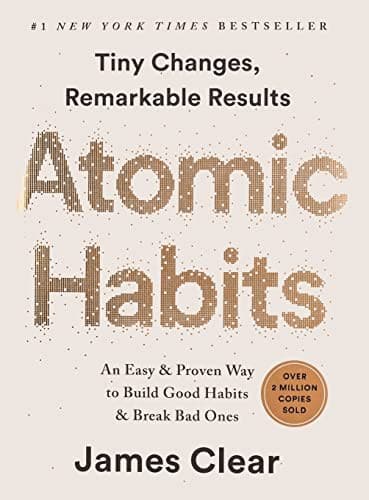
Atomic Habits
by James Clear · Published 2018
Small improvements become powerful when repeated consistently and supported by an environment designed to make good behaviors easier.
What works
- Highly practical.
- Excellent framework for habit formation.
- Strong focus on environment and systems.
- Easy to apply immediately.
What doesn't
- Many ideas build on earlier behavioral psychology.
- Can make behavior change seem more predictable than it really is.
- Some concepts are repeated throughout the book.
As an affiliate, I may earn a small commission if you buy through this link — at no extra cost to you.
Summary
Atomic Habits rests on a simple claim: behaviour change is not a motivation problem, it is a design problem. James Clear argues that people usually fail not because they don't want it badly enough, but because they have built a system that makes the right behaviour hard and the wrong one easy. His fix is to move the point of attention away from the behaviour itself and onto the conditions the behaviour happens in.
The book's spine is four laws — make it obvious, make it attractive, make it easy, make it satisfying — derived from the cue, craving, response, reward loop. To break a habit, the same four invert: invisible, unattractive, difficult, unsatisfying. None of this is new to behavioural psychology and Clear does not claim otherwise; what he does is convert a research literature into a set of decisions you can act on the same day.
The more consequential idea sits elsewhere. Clear argues habits are ultimately not about outcomes but about identity. The goal is not "run a marathon", it is "be a runner". Every time you perform a behaviour you cast a small vote for the kind of person you believe you are. That reframing explains much of the book's staying power: a goal is met once and then it is over, whereas an identity is re-established daily.
Clear opens the book with a personal story — about himself, not the reader: a severe head injury from a high-school baseball accident derailed his athletic path for years. His return came not from one big decision but from the daily, incremental rebuilding of training habits. That story sets the frame for the entire book: large change turns out to be the by-product of small repetition, not a single leap.
Key ideas
1. Systems beat goals
You do not rise to the level of your goals, Clear writes; you fall to the level of your systems. Goals set direction but they do not produce progress — the repeated process does that. His argument names three specific defects in goal-first thinking: winners and losers shared the same goal, so the goal was not the differentiator; hitting a goal produces temporary change because the conditions that created the problem are untouched; and a goal defers satisfaction, which means you are in a state of failure until the moment you arrive.
You do not rise to the level of your goals. You fall to the level of your systems.
The practical consequence is that the response to falling short is not a more ambitious target but a question about which part of the current process is broken. This is the point where the book separates from motivational writing and starts to resemble engineering.
Clear's central example for this is British Cycling. Before 2003 the team had won a single Olympic gold in a hundred years. Under Dave Brailsford, the team's approach became what he called the "aggregation of marginal gains": improving every measurable component by even a fraction of a percent — saddle design, a travel pillow for better sleep, even a specific hand-washing routine to reduce colds. No single change was impressive on its own; the compounded effect produced consecutive Olympic and Tour de France titles within a few years. Clear treats this as a concrete instance of his own principle: the right system produces a dramatic outcome even without a dramatic goal.
2. Compounding and the plateau of latent potential
One per cent better daily compounds roughly thirty-seven-fold over a year; one per cent worse takes you to near zero. The shape of the curve matters more than the arithmetic, though. Clear's point is that habit results arrive on a delay: you work for a long time and see nothing, and that gap — what he calls the plateau of latent potential — is exactly where most people quit.
This is more useful than it first appears because it changes the standard you judge by. If you expect today's effort to produce today's result, every unrewarded effort reads as evidence the method doesn't work. If you know the delay is structural, a stretch of no visible progress stops being data against you.
3. Environment beats willpower
The book's most repeated practical advice is to change the environment rather than strengthen self-control. People who appear more disciplined are usually just less exposed to temptation. Clear presents environment design as the primary lever: make the cue for the desired behaviour obvious, and remove the cue for the undesired one.
Two techniques follow. Habit stacking ties a new behaviour to one you already perform daily — after X, I will do Y — because an existing cue is more reliable than a new reminder. The two-minute rule shrinks the opening version of any habit until it is too small to skip; the logic is that you must first establish the habit of starting, not the habit of performing.
4. Identity, not outcome
Clear describes three layers of change: outcome, process, identity. Most attempts begin at the outermost layer (I want to lose ten kilos) and are brittle for that reason. Durable change comes from the innermost one (I am someone who doesn't miss workouts), because at that point the behaviour is no longer something endured on the way to a destination — it is an expression of how you see yourself.
The proposed mechanism runs both ways: a new belief produces new behaviour, and new behaviour supplies evidence for the new belief. This is why he insists the size of the habit is irrelevant at the start — one minute of practice casts the same identity vote as an hour.
5. Habit tracking and the "never miss twice" rule
Clear's fourth law — make it satisfying — leads him to habit tracking: marking a calendar or checking off a log every time the behaviour happens. His argument is that the brain responds to visible, immediate evidence; a chain of marked-off days becomes its own small, instant reward, while the real payoff of a habit — fitness, knowledge, savings — is only visible months later. Tracking fills that gap.
The companion rule is the one Clear singles out as more important than any other piece of advice in the book: never miss twice in a row. Missing once is an accident. Missing twice is the start of a new habit — the habit of not doing it. The book's emphasis on fast recovery over perfection comes directly from this.
Who it's for
- Anyone who knows what to do and doesn't do it — the book moves the problem from knowing to designing, which is precisely that gap.
- Anyone who has started and abandoned the same thing repeatedly — the plateau of latent potential and the two-minute rule target that pattern directly.
- Anyone looking for a framework to build a process — not only personal habits; the four laws apply to team and work processes too.
- Newcomers to the field — as an entry point into behavioural psychology it is more readable and better organised than most alternatives.
FAQ
If I've read The Power of Habit, is this still worth reading?
Yes, but for a different reason. Charles Duhigg's The Power of Habit explains how habits work; Atomic Habits explains what to do with that knowledge. The first is closer to narrative and research, the second to a manual. If you are reading only one and your aim is execution, read this one.
Is this just a repackaging of existing behavioural psychology?
Largely yes, and Clear does not hide it. The cue–craving–response–reward loop, compounding, and environment design are all prior work. The book's value is in conversion rather than discovery: it turns a scattered literature into a framework you can apply the same day. If your measure is scientific novelty, you will be disappointed.
How long does it take for a habit to stick?
The book gives no fixed number, which is to its credit. Clear explicitly rejects "21 days" and emphasises repetitions and consistency over elapsed days. The practical message is to stop asking how many days are left and start asking whether it happened today.
Does it apply to work and team habits?
Yes, and arguably better than to personal ones. At team level the four laws translate directly into friction reduction: the thing you want done should be the fewest-clicks option. The identity section transfers less well, though, since collective identity cannot be changed by an individual decision.
What is the book's main weakness?
Its optimism. The examples almost always succeed, and external variables — financial pressure, illness, job instability — are nearly absent. The result is that a reader may attribute a failed habit to personal weakness when sometimes the habit was never the problem. The middle chapters also repeat their own concepts more than necessary.
Is habit tracking actually necessary?
Not as a hard rule, but Clear treats it as the most direct way to implement "make it satisfying". If you already have another way to see progress — a measurable weekly result, for instance — you don't need a calendar and a checkmark; the underlying principle, immediate visible feedback, matters more than the specific tool.
Was this useful?
Counts appear once there are 5 votes.