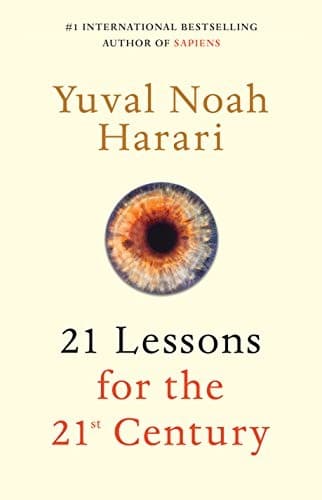
21 Lessons for the 21st Century
by Yuval Noah Harari · Published 2018
It raises important questions about the future, technology, politics and education more than it answers them. Some sections are oversimplified, but it is valuable for thinking about what is coming.
What works
- Raises important questions about AI, work, politics, education and truth.
- Very accessible.
- Encourages long-term thinking.
- Good discussion starter.
What doesn't
- Sometimes oversimplifies complex subjects.
- Some predictions are speculative.
- The breadth comes at the expense of depth.
Summary
Yuval Noah Harari writes 21 Lessons for the 21st Century as the third volume of his trilogy — after Sapiens (looking to the past) and Homo Deus (looking to the distant future), this book turns to the present: what matters most right now, in the face of technological and political disruption? Unlike the previous two books, Harari builds less of a cohesive historical narrative here and offers more of a collection of independent essays on varied topics — from work and politics to education and meaning.
The book's central thesis is that the grand narratives of the 20th century — fascism, communism, liberalism — which once offered comprehensive answers for organizing human society, aren't sufficient today for the central challenges of the 21st century (AI, the climate crisis, biotechnology). Harari argues that this ideological vacuum is itself a significant part of today's political confusion.
The book raises more questions than it answers. In many chapters, rather than offering a definitive solution, Harari simply builds a framework for thinking more carefully about a problem — an approach that's both the book's strength (as a discussion starter) and the main source of criticism against it (for occasionally oversimplifying complex subjects).
Key ideas
1. The collapse of grand narratives
Harari argues that the three great ideologies of the 20th century — fascism, communism, and liberalism — each claimed to offer a complete roadmap for humanity's future. Fascism and communism effectively failed, and liberalism, which looked like the victor after the Cold War, has no clear answer today to challenges like AI and the economic inequality driven by automation. The result, in Harari's view, is an ideological vacuum that has destabilized global politics in recent decades.
2. The "useless class" and the danger of automation
One of the book's most provocative warnings is this: increasing automation, unlike previous industrial revolutions that replaced lost jobs with new ones, might create a large class of humans who aren't merely unemployed but economically "useless" — meaning no economic investment in retraining them is justified, because algorithms will do both the physical and the cognitive jobs of the future better. Harari treats this not as a definitive prediction but as a danger that needs to be taken seriously starting now.
3. Nationalism versus global problems
Harari highlights a structural contradiction: humanity's biggest challenges today — climate change, nuclear weapons, AI regulation — are inherently global, and no single country can solve them alone. Yet existing political institutions remain organized mostly at the national level. This mismatch between the scale of the problem and the scale of governance, in his view, is one of the most dangerous institutional gaps of the present century.
4. The post-truth era and competing stories
In a chapter on truth, Harari makes a subtle argument: humans have always lived through story and myth — money, nationality, human rights are all "shared stories," not objective physical facts. So, in his view, the real battle of the present age isn't simply "truth versus lies"; it's a choice between stories that support constructive human cooperation and stories that feed division and violence.
5. Meditation as a response to algorithmic manipulation
In the book's closing section, Harari discusses his own personal experience with Vipassana meditation — not as spiritual advice, but as a practical tool for facing the growing danger of algorithms manipulating human attention and desires. His argument is: if companies and governments can understand and steer your emotions and wants better than you can yourself, the only real defense is a deeper knowledge of your own mind — a skill Harari treats not as a cultural preference but as a necessity for preserving individual autonomy in the coming century.
Who it's for
- Anyone who's read Sapiens and Homo Deus and wants to see Harari's view of the present — this book completes his trilogy.
- Anyone interested in today's global debates on politics, technology, and education — the book offers fresh angles for thinking about these topics.
- Anyone looking for a discussion starter for a group or classroom conversation — the book's short, independent chapters suit that purpose well.
- Anyone looking for deep, specialized analysis of any one specific topic — the book's breadth comes at the cost of depth; each chapter is an introduction, not a full treatment.
FAQ
How does this book connect to Sapiens and Homo Deus?
Together they form a cohesive trilogy: the first covers humanity's past, the second the distant future, and this book addresses the immediate challenges of the present.
What exactly is the "useless class"?
Harari's warning that increasing automation might create a group of humans who aren't just unemployed but hold no economic added value for the labor market — because algorithms perform those same jobs better.
Why is Harari concerned about nationalism and global problems?
Because challenges like climate change and AI regulation are inherently global, yet political institutions remain organized mostly at the national level — this mismatch makes effectively solving these problems difficult.
Why does Harari discuss meditation at the end of the book?
He treats meditation as a practical tool for gaining deeper knowledge of your own mind — a defense against the growing danger of algorithms and tech companies manipulating your emotions and decisions.
Does this book give definitive answers to the issues it raises?
Not mostly. The book raises questions more than it delivers final answers; its goal is to provoke deeper thinking, not to hand over a specific roadmap.
Was this useful?
Counts appear once there are 5 votes.